Chapter 2 of Samantabhadra
— o0o —
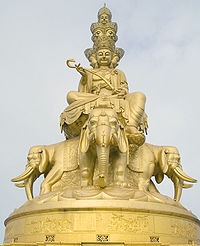 Scriptural Text: At that time, in the midst of the great assembly, Bodhisattva Samantabhadra rose from his seat, bowed at the Buddha’s feet, circumambulated three times to the right, knelt with palms joined, and said to the Buddha:
“Great Compassionate World-Honored One, please, for the bodhisattvas in this assembly and for all sentient beings in the Dharma-ending age who cultivate the Great Vehicle, explain how to practice after hearing this pure realm of Perfect Enlightenment. World-Honored One, if those beings know that all is like illusion, and that body and mind are also illusion, then how can they use illusion to cultivate illusion?
If all illusory natures are completely extinguished, then there is no mind. Who then is the one who practices? Why then speak of practicing like illusion? If sentient beings do not cultivate, and remain in illusory birth and death, never understanding the realm as illusion, how can their deluded, imagining minds be liberated?
Please, for all sentient beings in the Dharma-ending age, teach what skillful means and gradual steps should be used in cultivation so that beings may forever depart from all illusions.” Having said this, he prostrated with five points touching the ground, and repeated this request three times in the same way.
Commentary: The main point of this passage is that Samantabhadra Bodhisattva asks the Buddha:
1. If all beings know all dharmas are like illusion, then why practice? Since it is illusion, why still use an illusory body and mind to cultivate an illusory dharma?
2. If beings cling to “it is illusion” and do not practice, they remain in samsara forever. How then can liberation be attained?
In the previous chapter, Bodhisattva Manjushri, symbolizing fundamental wisdom, asked about the causal ground of the Buddhas’ practice. In this chapter, Bodhisattva Samantabhadra asks. He is often called Great Conduct Samantabhadra. In the Avatamsaka teaching, he symbolizes differentiated wisdom, the wisdom that adapts to conditions to teach beings and establish practices accordingly.
Samantabhadra raises four questions. First he asks the Buddha:
How should bodhisattvas in the assembly and all later beings practicing Mahayana cultivate after hearing the pure realm of Perfect Enlightenment?
If beings know all dharmas are like illusion, and body and mind are illusion, how can illusion cultivate illusion?
If all illusory natures are extinguished, there is no body-mind. Who then practices, and why still speak of practice like illusion?
If beings do not practice and stay in illusory birth and death, never understanding the illusory realm, how can delusive thoughts be ended for liberation?
He then requests the Buddha to teach expedient methods and gradual stages so beings may constantly leave illusions.
Samantabhadra asks about practical details of cultivation, because once details are clear, application becomes possible. Hearing the Buddha say body and mind are all illusion, doubt arises: “If body is illusion and mind is illusion, who practices? If no practice, must one remain in birth and death forever?” Many think body is illusion, mind is illusion, environment is illusion, so why cultivate at all? Practice seems needed only when things are taken as real: real right and wrong, real bad and good, then abandoning wrong and cultivating right, abandoning bad and cultivating good. If one does not practice and becomes careless, saying “it is all illusion, nothing to fear,” bad habits arise from misunderstanding illusion. Therefore Samantabhadra asks so the Buddha can clarify.
Scriptural Text: At that time, the World-Honored One told Bodhisattva Samantabhadra:
“Excellent, excellent! Good man, you are able, for all bodhisattvas and beings in the Dharma-ending age, to ask about cultivating the bodhisattva samadhi of illusion, and the expedient gradual stages by which beings can depart from all illusions. Listen carefully now, and I will explain for you.”
Then Samantabhadra Bodhisattva, joyfully receiving the teaching, together with the whole great assembly, listened in silence.
Commentary: Manjushri and Samantabhadra are two great bodhisattvas. Manjushri represents great wisdom. Samantabhadra represents great conduct. With great wisdom (fundamental wisdom), one can break root ignorance. With great conduct, one can complete the Buddha’s practices. A cultivator must always have both wisdom and conduct. With wisdom, ignorance is broken and truth is understood. With conduct, truth is realized and Buddhahood completed.
In this passage the Buddha praises Samantabhadra because he asks, for the sake of beings, about the practice of the “Samadhi of Illusion.”
We may contemplate all things as unreal, yet at times still see them as real; then we have not attained the samadhi of illusion. When in walking, standing, sitting, lying down, at any time and in any place, one fully sees all dharmas as unreal and illusory, then one has attained this samadhi.
Scriptural Text: “Good man, all sentient beings’ various illusory transformations all arise from the Tathagata’s wondrous mind of Perfect Enlightenment, like flowers in space arising from space. Though illusory flowers vanish, the nature of space is not destroyed. Beings’ illusory mind, in turn, is extinguished by means of illusion; when all illusions are exhausted, awakened mind does not move. Speaking of awakening based on illusion is also called illusion. If one says there is awakening, one has not yet left illusion; and if one says there is no awakening, it is also the same. Therefore when illusion is extinguished, this is called the unmoving.”
Commentary: Flowers in space are an analogy for phenomena; space is an analogy for Perfect Enlightenment. The central meaning is: all false, illusory dharmas in this world arise within Perfect Enlightenment (true mind). Illusory dharmas cease, but Perfect Enlightenment mind does not cease. Just as flowers appear in space and disappear, while space itself does not disappear.
Because “Perfect Enlightenment” is spoken in relation to delusive illusion, even that expression becomes part of relational convention. At this level, if one says “there is Perfect Enlightenment,” one has not left delusive duality; if one says “there is no Perfect Enlightenment,” one also has not left it. Therefore both delusive poles, being and non-being, must be extinguished; only then is it called Perfect Enlightenment.
The Buddha repeats the earlier point so we do not waver. He says all beings and all illusory realms, illusory mind and illusory environment, arise from the Tathagata’s wondrous mind of Perfect Enlightenment, not from elsewhere. He likens body, mind, and world to flowers in space: arising in space, ceasing in space, while space remains unharmed. Likewise, body-mind and phenomena may vanish, but awakening nature does not vanish.
On hearing this, one may think: if Perfect Enlightenment gives rise to illusions, does it produce ignorance? Is there an awakening that gives birth to ignorance? If this point is unclear, misunderstanding comes easily. Is it that space gives birth to flowers? No. Diseased eyes see flowers; space does not produce flowers. Likewise, awakening nature does not produce ignorance; ignorance arises when awakening nature is not recognized. Because awakening nature does not produce ignorance, when ignorance ends, awakening nature remains.
Thus awakening nature is the causal ground of our practice. The teaching affirms: beings’ illusory mind is extinguished by means of illusory dharmas. When illusory dharma and illusory mind are exhausted, Perfect Enlightenment nature is unmoving.
Take seated meditation as an example. When delusive thoughts arise, we see they are false. When they settle, ever-awake stillness remains full and clear; it has not disappeared. If ever-awake mind were gone, how could we know delusive thought had quieted?
The text shows clearly: when illusory mind is extinguished, the ever-awake unmoving mind appears.
If awakening is spoken in dependence on illusion, even that “knowing” is still within illusion. For example, when delusive thought arises, we “know the delusive thought.” Delusive thought is illusion, but the “knowing of delusive thought” is also still within the framework of illusion. If one clings to that “knowing” as real, one is still trapped in illusion.
Thus when delusive thought quiets, even the knowing of delusive thought must be released. When all is released, mind is thusness, unmoving. That unmoving mind is the real; as long as conceptual observation still arises, it is not yet complete.
Scriptural Text: “Good man, all bodhisattvas and sentient beings in the Dharma-ending age should depart from all illusory, false realms. Because they firmly uphold the mind of departing, the mind that departs is also illusion and must also be departed from. The departing that is illusion must also be departed from. The illusion of departing from departing must also be departed from. When nothing remains to depart from, all illusions are removed. It is like producing fire by friction: two pieces of wood depend on each other; fire appears and wood is exhausted, ashes fly and smoke disappears. Using illusion to cultivate illusion is also like this. Though all illusions are exhausted, one does not enter annihilation.”
Commentary: Good man, all bodhisattvas and future beings should leave the following:
1. Leave illusory and false realms. Yet the mind that knows “I am leaving” still remains.
2. That mind of leaving is also illusion, and must be left.
3. The very “leaving” is also illusion, and must be left.
4. The “leaving of leaving” is also illusion, and must be left.
5. One must reach the point where nothing remains to leave; only then are illusions truly removed.
It is like making fire by rubbing two pieces of bamboo or wood. Continue rubbing until fire emerges; then the fire burns the wood itself. When wood is gone, fire dies, ash scatters, and only open ground remains. So too with using illusion to cultivate illusory dharmas. When all illusions are exhausted, it is not annihilation; at that time Perfect Enlightenment nature appears by itself.
The main meaning is: a practitioner first departs from illusory objects, then departs from illusory mind, and departs until there is nothing left to depart from. Only then are all illusions ended. At that point, the non-illusory, the nature of Perfect Enlightenment, is revealed. Therefore Perfect Enlightenment nature is not annihilation.
As in the fire analogy: at first two sticks are rubbed (mind and object). When fire appears, it burns the sticks. When fire is spent and ash is gone (mind and object both ended), open ground remains (analogy for Perfect Enlightenment).
Scriptural Text: “Good man, knowing illusion is itself departure; no expedient is constructed. Departing illusion is itself awakening; there are also no gradual stages. All bodhisattvas and beings in the Dharma-ending age who cultivate according to this can then forever depart from all illusions.”
Commentary: The Buddha teaches that when one knows dharmas are unreal and illusory, one no longer clings to or craves them; that itself is departure from illusion, with no other separate method required.
This resembles a line in the Shurangama Sutra: “Awaken to delusion, and delusion ceases.” It is like someone in a dream who realizes it is a dream: then there is no more dreaming.
When delusive illusions are left, Perfect Enlightenment is immediately revealed. Therefore there is no step-by-step sequence.
Like when light arrives, darkness immediately vanishes; as darkness vanishes, light is present. There is no staged progression.
Earlier, Samantabhadra asked about stages for cultivating the Dharma gate of illusion. In this passage, the Buddha has completed the answer.
Scriptural Text: At that time, the World-Honored One, wishing to restate this meaning, spoke verses:
Samantabhadra, you should know,
All sentient beings,
Since beginningless time Have illusory ignorance.
All are established from The Tathagatas’
Mind of Perfect Enlightenment,
Like flowers in empty space,
Appearing by depending on space.
If the flowers vanish,
Space itself is originally unmoving.
Illusion arises from awakening,
When illusion ceases, awakening is complete,
Because awakened mind is originally unmoving.
If all those bodhisattvas,
And beings of the Dharma-ending age,
Constantly depart from illusion,
All illusions are thereby departed from,
Like producing fire from wood:
When wood is exhausted, fire also ceases.
Awakening has no gradual stages;
Expedient means are also like this.