Chicken came first or Egg came first
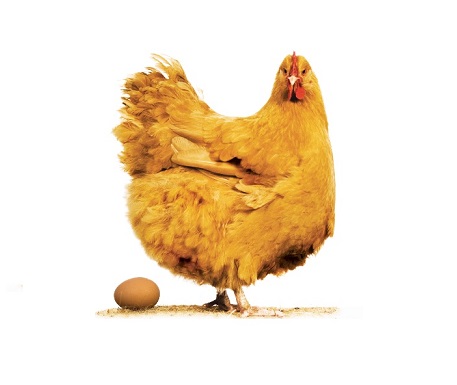 The question of whether the chicken came first or the egg came first is a puzzling one that has caused many people to rack their brains trying to think it through and explain it. Some people argue that when a chicken reaches reproductive age, it lays eggs, so one can conclude that the chicken came first. From another perspective, eggs hatch into chickens. Then again, without eggs, how could chickens hatch? In today’s essay, we will answer this question through two explanations, a story, and an example.
For example: A child lives and grows up in the city. Occasionally, the parents feed the child boiled eggs or fried eggs with bread. In the child’s eyes, there are only chicken eggs. One day, the father visits his family in the countryside. When he goes into the backyard, he sees several hens laying eggs. He picks up a few eggs and brings them back to the city as a gift for the child. After returning home, one of the eggs hatches into a cute little chick.
======
When the father sees the hen laying eggs, he thinks the chicken came before the egg. Meanwhile, in the child’s eyes, seeing the egg hatch into a chick, the child thinks the egg came before the chicken. So who is right and who is wrong?
If we speak generally about all eggs or all chickens, we easily fall into dualistic reasoning: Did the chicken come first or the egg come first? This is called the Two (Dual) Dharmas. A practitioner should not let themselves fall into duality. You should remember that the Buddhadharma is non-dual. Non-duality is the true reality. So what is the true reality of the example above?
– For the newly hatched chick, the egg came first.
– For the egg, the mother hen came first.
So there are two chickens and one egg. Let me ask you: Have you ever seen two hens lay one egg together? Or one egg hatch into two chickens?
Now that you understand how to answer this question, we will go one step deeper and continue the story of the chicken.
======
When the child sees the egg hatch into a very cute little chick, the child asks the parents for permission to raise it. Five months pass, and the little chick grows into a mature hen. One beautiful morning, the child wakes up early and gets ready for school. Walking into the backyard, the child sees that the hen has just laid an egg. Excited, the child runs into the house and says to the parents:
“Dad, our chicken just laid an egg. That’s great! We’re going to have another chicken soon.”
The father smiles and replies:
“That egg is only for eating. If you want an egg to hatch into a chicken, you need both a hen and a rooster.”
The child looks at the father with confusion and says:
“I don’t understand.”
The father answers:
“In this world there are twelve kinds of living beings. Living beings arise through the coming together of many conditions. Broadly speaking, there are four kinds:
– Those born from a womb, like humans.
– Those born from eggs, like chickens.
– Those born from moisture, like microorganisms.
– Those born through transformation, like butterflies.
Long ago, your mother and I met, loved each other, and your mother became pregnant and gave birth to you. Therefore, humans are called womb-born. Womb birth comes from affection. Because there is emotional attachment, children are born into the world.
As for your hen, it is an egg-born creature. Eggs are born from thought. Your hen spends all day imagining and longing for chicks, so it lays this egg. This egg is produced from thought, but without affection and union with a rooster, it cannot hatch into a chick.
For example, suppose you want a paper airplane. If you do not actually fold paper into an airplane and only imagine it in your mind, will the airplane take shape?”
The child replies:
“No.”
The father continues:
“This egg is the same. Your hen merely imagined having chicks, so it laid this egg. Therefore, it cannot hatch into a chick. If you want an egg to hatch, the hen must unite with a rooster. Only then can it lay a fertilized egg that can hatch into a chick.”
The child replies:
“Yes, I understand now.”
=======
Long ago, a Buddhist