East, South, West, North
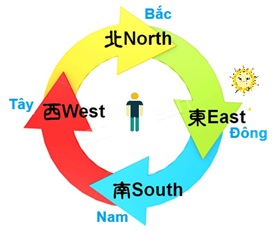 “Ordinary convention in discussing directions: in the sutras, whenever the ten directions are mentioned, the East is usually named first.”
The usual way of speaking about directions, when referring to the ten directions, is to mention the East first.
“Ordinary convention” means habit or custom. Vietnamese people are accustomed to saying “East, South, West, North,” not “South, North, West, East.” Indians speak in the same way. This is simply a convention. According to custom, the East is placed first. Corresponding to the four seasons, the East is associated with spring. In spring, all things grow and flourish; it symbolizes wisdom and conveys this meaning. Buddhism places great importance on wisdom. Buddhism seeks ultimate and perfect wisdom. Therefore, wisdom leads all dharmas. Regardless of sect or method—whether the eighty-four thousand Dharma gates or immeasurable Dharma gates—the goal is only one: the attainment of wisdom. The methods and approaches differ, but the objective is the same. Once wisdom is awakened, the goal of one’s cultivation has been achieved. In other words, one’s method is certainly correct and has reached its destination. If wisdom does not arise, it is not that the Dharma method is wrong, but rather that one’s practice is not in accordance with the proper principles, or it is unsuited to one’s capacities, and thus awakening cannot occur. Therefore, in cultivation, choosing a Dharma method is one of the most important issues.
For example, when we become ill and go to see a doctor, the doctor diagnoses the illness and prescribes medicine. Cultivation is the same. When the Buddha was in the world, his disciples only needed to meet the World-Honored One. The Buddha could observe their capacities. He could see their past, and even their past lives, extending through immeasurable kalpas. He could see what they had practiced life after life. Seeing that their faculties had matured, the Buddha would introduce a Dharma method perfectly suited to them. Success could come very quickly—sometimes within days, or at most within a few months. This is called “teaching according to the individual’s capacities.” Today, in the Age of Dharma Decline, Buddhist practitioners are far inferior to those of the Semblance Dharma and Right Dharma periods. Our blessings are too meager, and we lack the opportunity to encounter true spiritual teachers. Even when we do meet them, we may not recognize them or value the opportunity to learn the Dharma and awaken wisdom. Just as at the beginning of a sutra, the leading members of the assembly are named: among the Śrāvakas, Śāriputra is listed first because he possessed the greatest wisdom; among the Bodhisattvas, Mañjuśrī is named because he possessed supreme wisdom. This demonstrates that what we seek is wisdom, and what we cultivate is also wisdom.
In the sutras, Śākyamuni Buddha resides in the Sahā World, and he himself is at the center. East, South, West, and North make up the four directions. The Buddha taught in the Sahā World, and the Sahā World is regarded as the center. This implies that the “center” has no fixed location; one takes oneself as the center. Similarly, this essay is now on the internet and can be read by people all over the world. Therefore, it has no fixed location, yet it can exist throughout all directions.
Vairocana Buddha, the Pure Dharma Body Buddha spoken of in the Avataṃsaka Sutra, is the Dharma Body Buddha. The name “Vairocana” is a Sanskrit transliteration meaning “Pervading All Places.” Modern philosophy calls this the “noumenon,” the fundamental substance of all existence in the universe. Buddhism calls it the Dharma Body (Dharmakāya). All phenomena in the universe arise from the Dharma Body. The Dharma Body can give rise to all dharmas, yet it itself is neither born nor extinguished. It is unborn and undying. Since it pervades all places, how could it come or go? It is like empty space: space pervades everywhere. Have you ever seen space come or go? Space neither comes nor goes.
The “center” does not refer to our physical body, but to our true mind and original nature. The true mind is unborn and undying; it neither comes nor goes. The entire universe and all phenomena are manifestations of the true mind. The true mind is that which transforms and manifests; all phenomena are what is manifested. Where does the great cosmos come from? When the self-nature is deluded, such realms appear. When the self-nature is awakened, such realms do not exist. Therefore, one cannot say that these realms exist, nor can one say that they do not exist. They are neither existent nor nonexistent. This is the truth of reality. It is like a dream: one cannot say that the dream realm exists, yet one cannot say it does not exist. If you say it does not exist, there was clearly an experience while dreaming. Upon waking, you still remember it vividly. If you say it exists, once awake, you cannot find it anywhere. In reality, our situation is precisely like a dream. Therefore, the Buddha taught us in the Śūraṅgama Sutra to contemplate in this way:
“All conditioned phenomena are like dreams, illusions, bubbles, shadows, dew, and lightning; thus should they be contemplated.”
In the Śūraṅgama Sutra, the Buddha gives an interesting analogy. If our eyes are diseased, we may see a halo around a lamp. That halo is an illusory appearance. Delusion gives rise to illusory forms; awakening removes them. In reality, there is no halo around the lamp. Deluded beings see the six realms of rebirth and the great trichiliocosm; awakened beings do not.
In the Amitābha Sutra, the first Buddha mentioned is Akṣobhya Buddha (the Immovable Buddha) in the East. The East corresponds to spring among the four seasons and to the Zhen trigram in the Later Heaven Bagua. Zhen signifies movement. Its meaning is profound and complete, illustrating the principle that movement and stillness are one. Movement refers to Śākyamuni Buddha traveling everywhere to teach the Dharma. He journeyed throughout India, from Nepal in the north to Sri Lanka in the far south, throughout the Ganges basin. He moved. His body moved, his speech moved, yet his mind remained unmoving. Within his mind there never arose discriminating thoughts. He never generated distinctions or attachments. Within movement there was stillness; within stillness there was movement. Thus, he remained immovable.
This passage is intended to express precisely that meaning. “At once movement, at once stillness”—movement and stillness exist simultaneously. In learning Buddhism, we must grasp this principle. The earth rotates, the sun rises and sets, but in daily life the mind should remain pure and empty. Nothing should be harbored within it. The Buddha taught us not to give rise to discriminating thoughts. If we can eliminate the discriminating mind, prajñā wisdom will naturally appear. The reason so little prajñā manifests in us is that our discriminating thoughts occupy all the space, leaving no room for wisdom to emerge. The eight consciousnesses are originally pure, but because they contain discrimination, they become defiled. If we can eliminate discrimination, it is like sweeping away rubbish. Everything will return to purity, and wisdom will appear.
The transformation bodies of Buddhas come and go,
Yet the Tathāgata is forever unmoving.
Within the realm of the Dharma,
It is neither one nor different.