Precepts, Concentration, and Wisdom
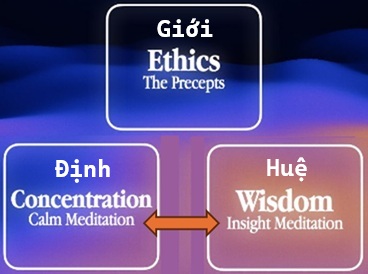 Precepts, Concentration, and Wisdom are also called the Three Stainless Trainings (Tam Vô Lậu Học). In summary, they are nothing other than “purity, equality, and enlightenment.” These three encompass the entirety of the Buddha’s teachings. In terms of the Three Stainless Trainings: Purity is Precepts, Equality is Concentration, and Enlightenment is Wisdom.
Why is purity called Precepts?
Purity of the three karmas: body, speech, and mind. When the three karmas are pure, one is a sage. When they are impure, one is an ordinary being. When the three karmas conform to the standard, they are wholesome; when they do not, they are unwholesome. First, let us discuss the ten evils of the three karmas, also known as the ten precepts:
– When the body is impure, three evils arise: killing, stealing, and sexual misconduct.
– When speech is impure, four evils arise: lying, frivolous speech, divisive speech, and abusive speech.
– When the mind is impure, three evils arise: greed, anger, and ignorance.
If someone begins to believe in the Buddha’s teachings and generates the Bodhi mind to walk the Bodhisattva path, they must first take refuge in the Three Jewels: the Buddha, the Dharma, and the Sangha. Taking refuge in the Buddha prevents falling into hell; taking refuge in the Dharma prevents falling among hungry ghosts; taking refuge in the Sangha prevents rebirth as an animal. This is the initial rite of entering the Buddhist path. After that, one observes the Five Precepts:
1. Do not kill (purifies the body)
2. Do not steal (purifies the body)
3. Do not engage in sexual misconduct (purifies the body)
4. Do not lie (purifies speech)
5. Do not consume intoxicants (purifies the mind)
After receiving the Five Precepts, one must certainly uphold them. Each precept is protected by five benevolent Dharma-protecting spirits. If one keeps the Five Precepts, twenty-five benevolent spirits will protect that person, turning misfortune into fortune and danger into auspiciousness. If one violates the precepts, those 25 benevolent spirits will depart.
Monastics receive additional precepts. Novices monk (Sa-di) receive ten precepts. Bhikshus receive 250 precepts. Bhikshunis receive 348 precepts and also the Bodhisattva precepts (10 major and 48 minor precepts). Only when these are fully observed is one truly a monastic. Laypeople should uphold the first five precepts upon taking refuge, along with the ten precepts related to the three karmas, in order to be true Buddhist disciples.
Precepts can awaken the root of Bodhi.
One should diligently cultivate this field of merit.
In precepts and learning, always practice accordingly.
All Thus-Come Ones praise such conduct.
Precepts mean preventing evil and avoiding wrongdoing. They also mean refraining from all evil and practicing all good. By refraining from evil, greed, anger, and delusion are eliminated; by practicing good, one diligently cultivates precepts, concentration, and wisdom. Cultivating precepts, concentration, and wisdom is precisely the development of the Bodhi root. If one wishes to attain awakening, one must keep the precepts. To keep the precepts, one must first have faith. Only by trusting the Buddha’s teachings can one uphold the precepts, and only by upholding the precepts can one develop the foundational Dharma of the Bodhi path.
— oOo —
Why is Equality called Concentration and Enlightenment called Wisdom?
Equality is Concentration—but equality of what? This refers to the Wisdom of Equality Nature (Bình Đẳng Tánh Trí), which arises when the seventh consciousness is transformed into wisdom. Before cultivation and before understanding the meaning of concentration, it is called the seventh consciousness. After enlightenment, it is called the Wisdom of Equality Nature.
The seventh consciousness is also called Manas consciousness, or the transmitting consciousness. It receives information from the sixth consciousness (mental consciousness) and transmits it to the eighth consciousness, hence its name. The eighth consciousness is also called the storehouse consciousness (Ālaya-vijñāna). Seeds of both good and evil are stored there. Therefore, planting good causes produces good results, while planting evil causes produces evil results. It is called the field of the eighth consciousness because it is like a field: whatever one plants there will grow. If one does not keep the precepts, evil karma is created and remains in this field.
“The Wisdom of Equality Nature is a mind without sickness.” Equality means that the minds of Buddhas and sentient beings are equal. “Without sickness” means free from obstructions, jealousy, greed, anger, and ignorance. If one is free from these afflictions, the seventh consciousness can be transformed into the Wisdom of Equality Nature—this is concentration and wisdom. The equal mind is concentration. Awakening (Buddhahood) is wisdom. The equal mind is right mindfulness. Therefore it is said: “Mind itself is Buddha.” The Sixth Patriarch Huineng said: “The previous thought not arising is Mind; The next thought not ceasing is Buddha. Creating all appearances is Mind; Leaving all appearances is Buddha.”
If I were to explain it fully, I could speak for kalpas and never finish. Listen to this verse:
Mind itself is wisdom; Buddha itself is concentration.
Concentration and wisdom are equal, and the mind is completely pure.
Awakening to this Dharma gate depends on your own nature.
Its function is originally unborn; cultivating both together is the proper path.”
Mind itself is wisdom; Buddha itself is concentration. This is also called concentration and wisdom. “Mind itself is Buddha” is also “concentration itself is wisdom.” Concentration, wisdom, mind, and Buddha are equal. Mind is Buddha, Buddha is mind; concentration is wisdom, wisdom is concentration. Concentration and wisdom are mind and Buddha; mind and Buddha are concentration and wisdom. They are all one essence.
Your thoughts should contain purity (keeping the precepts). If you understand this sudden-teaching Dharma gate, you will realize that Buddha cannot be separated from mind, nor mind from Buddha; wisdom cannot be separated from concentration, nor concentration from wisdom. Concentration itself is wisdom, wisdom itself is concentration; mind itself is Buddha, Buddha itself is mind. Why do people fail to understand this? Because through countless lifetimes they have accumulated habitual tendencies that obstruct them. Originally, wondrous functioning is neither born nor destroyed. Therefore, cultivating the mind is cultivating Buddha; cultivating Buddha is cultivating the mind. Cultivating concentration is cultivating wisdom; cultivating wisdom is cultivating concentration. This is the true Dharma.
— oOo —
Without Precepts, Where Can Meditation Lead?
Without precepts, the mind cannot become pure. If the mind is impure, it is pulled about by external conditions. Seeing beautiful things with the eyes gives rise to greed; hearing unpleasant sounds gives rise to anger. The five sense faculties (eyes, ears, nose, tongue, body) encounter the five objects of sense, producing the five consciousnesses. Without keeping the precepts, the mind cannot maintain equality.
Many cultivators today do not wish to keep the precepts and therefore say: “Cultivating the Three Bodies (Dharma Body, Reward Body, Transformation Body) and the Four Wisdoms is sufficient.” They do not understand that cultivating the Dharma Body means cultivating the Pure Dharma Body, while keeping precepts means maintaining purity of body and mind. If the mind is impure, it is shaken by circumstances.
If the mind is pure, meditation may lead to concentration and wholesome, favorable, joyful states. If the mind is impure, one may encounter evil, adverse, and troubling states. Remaining attached to such states makes it difficult to overcome demonic influences, namely the four kinds of demons: heavenly demons, spirit demons, ghost demons, and human demons.
If one abides in the unsurpassed courageous path,
One can destroy all demonic powers.
If one can destroy all demonic powers,
One can transcend the realms of the four demons.
1. Heavenly Demons: Demons dwelling in heavenly realms. If a practitioner has not overcome attachment to wealth, heavenly demons use riches to tempt them, stirring greed and disturbing their purity. If attachment to sensuality remains, heavenly demons may appear as beautiful women or handsome men, causing infatuation and loss of spiritual attainment.
2. Spirit Demons: Beings possessing supernatural powers. They may dwell on islands, mountains, or forests. Seeing cultivators, they may challenge them or compete with them. If the practitioner’s virtue is stronger, the demon is subdued; otherwise, the practitioner may become part of the demon’s retinue.
3. Ghost Demons: Harmful ghosts that not only create trouble but also damage one’s wisdom-life. They can disturb practitioners and weaken their resolve. The Śūraṅgama Sūtra speaks of fifty skandha-demons that can confuse cultivators. Therefore, regardless of what states arise, one must maintain concentration and not be moved by them.
4. Human Demons or Affliction Demons: People who obstruct cultivators through jealousy and interference. They intentionally create difficulties to provoke anger and ignorance. Affliction demons are greed, anger, delusion, arrogance, and doubt. These five fundamental afflictions harm body and mind and become stumbling blocks on the path.
— oOo —
Purity Is Precepts
Every day one should reflect: “Were my actions today pure?” If they were, one should strive to become even purer. If they were not, one should correct oneself and begin anew.
If keeping the precepts feels difficult, understand that in many past lives one accumulated much negative karma. Those karmic seeds remain in the field of the eighth consciousness and manifest in this life as consequences of past causes. One should sincerely repent. In this way, the three karmas can begin to become pure. A simple repentance verse is:
“In the past I created countless evil deeds,
All arising from beginningless greed, anger, and delusion.
Produced through body, speech, and mind,
I now sincerely repent them all.”
After repentance, how can one attain purity of body, speech, and mind?
– By diligently cultivating precepts, concentration, and wisdom, the three karmas become free from faults.
– By eliminating greed, anger, and ignorance, the three karmas become pure.
– By relying on determination, sincerity, and perseverance, one protects the three karmas from harm.
– By carefully guarding the precepts, one prevents internal causes from leading to violations.
– By cultivating the three karmas as indestructible as vajra, one remains unmoved by any circumstance.
– By avoiding retreat from practice and maintaining perseverance, one prevents backsliding.
– By remaining unshaken by external conditions, one avoids creating evil karma.
– By benefiting beings selflessly, one transforms the three karmas into supreme merit.
– By removing impure thoughts and sensual desires, the three karmas naturally become pure.
– By eliminating improper thoughts, the mind becomes pure and the three karmas are no longer defiled.
– By allowing wisdom to guide one’s conduct, one walks the great path of light and purity.
— oOo —
Concentration and Wisdom
Concentration arises from precepts. Concentration is the essence of wisdom, and wisdom is the function of concentration. Therefore, precepts, concentration, and wisdom are called the Three Stainless Trainings. One who keeps precepts can attain freedom from defilements. One who cultivates concentration can attain freedom from defilements. One who develops wisdom can attain freedom from defilements. Thus, if one wishes to attain concentration, one must first uphold the precepts. How is this done? By “refraining from all evil and practicing all good.”
The Sixth Patriarch taught all beings: “Good friends! My Dharma gate of sudden enlightenment takes concentration and wisdom as its foundation. Do not mistakenly think concentration and wisdom are two separate things. They are one essence. Concentration is wisdom; wisdom is concentration. Though they have two names, their essence is one. Concentration is the essence of wisdom; wisdom is the function of concentration. Through concentration, wisdom arises. When wisdom is present, concentration is within wisdom. When concentration is present, wisdom is within concentration. Understanding this principle means understanding the equality and unity of concentration and wisdom.
Do not say that concentration must come first and wisdom later, or that wisdom must come first and concentration later. Such views separate what is fundamentally one. If one speaks beautiful words but internally harbors jealousy, arrogance, wrong views, greed, anger, and delusion, then one’s concentration and wisdom are merely empty words. When mind and speech are both wholesome, inside and outside are consistent, and mind and speech are one—this is the equality of concentration and wisdom. Self-cultivation is not about arguing with words or seeking reputation. Those who argue over whether concentration precedes wisdom or wisdom precedes concentration are deluded ordinary people. As it is said:
‘Debate gives rise to thoughts of winning and losing.
This is contrary to the Way.
It produces attachment to the four marks.
How can samādhi be attained?’
Without samādhi, there is neither concentration nor wisdom. As long as the desire to win and lose remains, attachment to self and attachment to phenomena remain. As long as these attachments remain, one cannot transcend the four marks: self, person, sentient being, and lifespan.
Good friends! What are concentration and wisdom like? They are like a lamp and its light. Where there is a lamp, there is light; where there is light, there is a lamp. Without the lamp there is no light; without the light there is no lamp. Though lamp and light appear to be two, they are actually one. The lamp is the essence of the light, and the light is the function of the lamp. Concentration and wisdom are the same way.”
“If the mind is equal, why labor over precepts?
If conduct is upright, why need meditation?”
A mind of equality means freedom from greed, anger, and delusion. Why are precepts necessary? Because people still possess these three poisons. If one truly has an equal mind, free from ignorance, then there is no need for strenuous effort in keeping precepts. Upright conduct itself is meditation. Meditation teaches one to eliminate bad habits and afflictions. Some hear, “An equal mind needs no precepts,” and conclude, “Then I need not keep precepts.” But has their mind truly become equal? If not, how can they abandon precepts? If one still acts selfishly, seeks personal gain, envies others, and creates obstacles, then one’s mind is not equal.
Learning means studying all Dharma teachings. To understand all Dharma, one must study diligently. The Analects says: “To learn and constantly practice what one has learned.” Through reviewing the old, one comes to know the new. In studying the Buddha’s teachings, one must diligently cultivate merit and virtue. It is like nurturing the Bodhi tree and increasing the fruits of Bodhi. One should respect the precepts and cultivate according to them. One should always practice accordingly and avoid violating or breaking them. Those who uphold the precepts and cultivate in this way are praised by all Buddhas of the ten directions and three times. They are continually protected by them. Keeping the precepts purifies the mind, and when the mind is pure, delusive thoughts no longer arise.
When delusive thoughts do not arise, that is Zen.
Sitting and seeing one’s self nature, that is Concentration.