Twelve Links of Dependent Origination
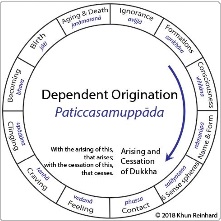 Before the Buddha was reborn in the Sahā world, non-Buddhist teachers often said that all things were born from the god Mahā-īśvara. Some said they were born from the god Viṣṇu. Some said they were born from combination. Some said they were born from time. Some said they were born from the nature of the world. Some said they were born from transformation. Some said they were born naturally. Some said they were born from atoms. Because of such errors, they fell into wrong views such as no cause, wrong cause, annihilationism, eternalism, etc., and theories of self and primordial self, failing to understand the true Dharma. The Buddha wished to eliminate those wrong views and enable people to understand the Buddha-Dharma, so he first explained the Twelve Links of Dependent Origination to non-Buddhists: Ignorance, Volitional Formations, Consciousness, Name-and-Form, Six Sense Bases, Contact, Feeling, Craving, Clinging, Becoming, Birth, and Death.
Ignorance conditions Volitional Formations,
Volitional Formations condition Consciousness,
Consciousness conditions Name-and-Form,
Name-and-Form conditions the Six Sense Bases,
The Six Sense Bases condition Contact,
Contact conditions Feeling,
Feeling conditions Craving,
Craving conditions Clinging,
Clinging conditions Becoming,
Becoming conditions Birth,
Birth conditions Aging and Death.
The Buddha taught the Twelve Links of Dependent Origination during the Āgama period (the early years when the Buddha taught the most fundamental and original Buddhist scriptures, recording his direct teachings on the Four Noble Truths, the Noble Eightfold Path, Dependent Origination, and Karma. This forms the common doctrinal foundation for both Theravāda and Mahāyāna Buddhism, corresponding to the Pāli Nikāya system of thought).
After the Āgama period, when Ānanda encountered the daughter of Mātaṅgī, the Buddha taught the Śūraṅgama Sūtra. In that sūtra, the Buddha also explained the meaning of the third link, “Consciousness conditions Name-and-Form,” through a discourse on arising and ceasing.
“Birth exists because of Consciousness;
Cessation is eliminated through Form.”
Five hundred years after the Buddha’s passing, during the age of Semblance Dharma, people’s faculties became dull. They became deeply attached to phenomena and sought the truly existent and determinate nature of the Twelve Links of Dependent Origination, the Five Aggregates, the Twelve Sense Bases, and the Eighteen Elements. Failing to understand the Buddha’s intent, they clung only to words. Hearing that Mahāyāna taught “ultimate emptiness,” but not understanding through what causes and conditions things are empty, they developed attachment and doubt: “If everything is ultimately empty, how can there be distinctions of karmic retribution for good and evil? Would there then be neither conventional truth nor ultimate truth?” Clinging to this notion of emptiness, they gave rise to attachment and many misunderstandings regarding the meaning of ultimate emptiness.
For these reasons, during the age of Semblance Dharma, Bodhisattva Nāgārjuna composed the following teaching:
Neither arising nor ceasing,
Neither eternal nor annihilated,
Neither one nor different,
Neither coming nor going.
This teaching of dependent origination
Skillfully removes all idle speculation.
I bow my head in homage to the Buddha,
The supreme teacher of the Dharma.
This verse discusses eight matters: arising, ceasing, permanence, annihilation, oneness, difference, coming, and going, with the purpose of dismantling all fixed views of phenomena.
— o0o —
Arising, ceasing, permanence, annihilation, oneness, difference, coming, and going
“Not arising” means that various philosophers held many different theories concerning arising. Some said cause and effect are one. Some said cause and effect are different. Some claimed the effect already exists within the cause; others claimed it does not. Some asserted self-generation; others generation by another. Some said things arise through the combination of self and other. Some said they arise from existence, while others said they arise from nonexistence (spontaneously, without cause). Such theories concerning the arising of things are incorrect. Since a definite characteristic of arising cannot be established, it is called “not arising.” “Not ceasing” means that if there is no arising, then there is nothing that can cease. Since there is no arising or ceasing, the other six categories likewise do not exist.
Why then mention the other six? To complete the meaning of neither arising nor ceasing. Some people cannot accept the meaning of neither arising nor ceasing but believe only in neither permanence nor annihilation. If one deeply investigates the meaning of neither permanence nor annihilation, one enters the meaning of neither arising nor ceasing.
Why? If phenomena truly exist, they cannot become nonexistent. If they existed before and now do not, that is annihilation. If they possess an inherent nature from the beginning, that is permanence. Therefore, by saying neither permanent nor annihilated, one enters the meaning of neither arising nor ceasing. Some hear the first four gates (neither arising, neither ceasing, neither permanent, neither annihilated) as negating all phenomena, yet still use the remaining four gates (oneness, difference, coming, going) to establish phenomena. This is incorrect. If things are one, there can be no causes and conditions. If they are different, there can be no continuity. These will be refuted individually below. Thus it is also said: neither one nor different.
Some hear the six gates (neither arising, neither ceasing, neither permanent, neither annihilated, neither one, nor different) as negating all phenomena, yet still use coming and going to establish them. “Coming” means that things come from Īśvara, from the nature of the world, from atoms, etc. “Going” means returning to their original place. Furthermore, all things do not truly arise.
— o0o —
Using rice grain as an example
Why? Because this is observed in the world. Looking at the beginningless past, rice was not seen to arise.
Why? Because apart from the rice of the primordial age, present rice could not exist. Only if present rice could exist independently of primordial rice could it be said to arise. But in reality, this is not so.
Question: If it does not arise, must it then cease?
Answer: It does not cease. Why? Because this is observed in the world. Rice from the primordial age is not seen to have ceased. If it had ceased, there could be no rice now. Yet rice does exist. Therefore, it does not cease.
Question: If it does not cease, must it be permanent?
Answer: It is not permanent. Why? Because this is observed in the world. Things are not permanent. When a rice grain sprouts, the grain itself deteriorates. Therefore, it is not permanent.
Question: If it is not permanent, must it then be annihilated?
Answer: It is not annihilated. Why? Because this is observed in the world. Things are not annihilated. A sprout comes from a rice grain. Therefore, it is not annihilated. If it were annihilated, continuity would be impossible.
Question: Then are all things one?
Answer: They are not one. Why? Because this is observed in the world. Things are not one. A rice grain is not a sprout, nor is a sprout a rice grain. If the rice grain were the sprout and the sprout were the rice grain, they would be one. But this is not so. Therefore, they are not one.
Question: If they are not one, must they be different?
Answer: They are not different. Why? Because this is observed in the world. Things are not different. If they were different, why distinguish rice sprouts, rice stalks, and rice leaves instead of calling them tree sprouts, tree branches, and tree leaves? Therefore, they are not different.
Question: If they are not different, must there be coming?
Answer: There is no coming. Why? Because this is observed in the world. Things do not come. A sprout within a rice grain does not come from elsewhere. If it came, it would have to arrive from another place, like a bird landing on a tree. But this is not so. Therefore, there is no coming.
Question: If there is no coming, must there be going?
Answer: There is no going. Why? Because this is observed in the world. Things do not go. If there were going, one should see the sprout leaving the rice grain, like a snake crawling out of a hole. In reality, this is not so. Therefore, there is no going.
— o0o —
The Four Modes of Birth
The Four Modes of Birth are: self-arising, arising from another, arising from both, and arising without cause.
Phenomena do not arise from themselves,
Nor do they arise from another,
Nor from both, nor without cause;
Therefore, they are known to be unborn.
“Not self-arising” means that things do not arise from their own essence; they necessarily depend upon sufficient causes and conditions. Furthermore, if a thing arose from itself, one thing would have two aspects: the thing produced and the producer. If it required no causes and arose from itself alone, there would be no causes and conditions, and arising would generate arising endlessly, without limit. Since self-arising does not exist, arising from another also does not exist. Why? Because “other” exists only in relation to “self.” If it does not arise from itself, it likewise does not arise from another.
Arising from both self and other inherits the errors of both self-arising and arising from another. If things existed without cause, then everything would be eternal. This is incorrect, because without cause there can be no effect. If effects existed without causes, then generosity and moral discipline could lead to hell, while the ten evil deeds and the five heinous crimes could lead to heaven, since there would be no causal basis.
Just as the intrinsic nature of phenomena
Is not found within conditions,
Since intrinsic nature does not exist,
The nature of otherness also does not exist.
The intrinsic nature of phenomena is not already present within conditions (that is, within interdependent circumstances). Phenomena are merely designated through the coming together of conditions. Intrinsic nature means self-essence. Since intrinsic nature is not found within conditions, there is no self-arising. Since intrinsic nature does not exist, other-nature also does not exist. Why? Because other-nature exists only in relation to self-nature. For another thing, that “other-nature” is itself a self-nature. To refute self-nature is to refute other-nature. Therefore, things cannot arise from other-nature. Refuting self-arising and arising from other also refutes arising from both.
As for arising without cause, it contains even greater errors. If arising through causes can be refuted, how much more so arising without cause. Among these four possibilities—self-arising, arising from another, arising from both, and arising without cause—the characteristic of arising cannot be found. Therefore, it is said to be unborn.
— o0o —
The Four Conditions
Question: The Abhidharma scholars say that all phenomena arise from four conditions. Why then say there is no arising? What are the four conditions?
Causal Condition, Immediately Preceding Condition,
Object Condition, and Dominant Condition.
These four conditions give rise to phenomena;
There is no fifth condition.
Answer: All conditions are included within these four. Through these four conditions, all phenomena arise.
Causal Condition refers to all conditioned phenomena.
Immediately Preceding Condition refers to past and present mind and mental factors, except the final mind and mental factors of an Arhat.
Object Condition and Dominant Condition refer to all phenomena.
— o0o —
Causal Condition & Immediately Preceding Condition
Does the effect arise from conditions,
Or from nonconditions?
Do those conditions already contain the effect,
Or originally contain no effect?
If one says the effect arises from conditions, then does the effect already exist within those conditions or not? Neither position is correct. (Anything produced from a different cause is called an effect.) Why?
If a phenomenon produces an effect,
That phenomenon is called a condition.
When the effect has not yet arisen,
Why is it not called a noncondition?
Conditions have no fixed nature. Why? Before the effect arises, the thing is not called a condition. Only after seeing the effect arise from it do we call it a condition. A condition becomes a condition because of the effect. Since the effect comes later and the condition earlier, before the effect exists, why should it not be called a noncondition? For example, a pot arises from clay and water. Seeing the pot, we call clay and water the conditions for the pot. But before the pot existed, why not call clay and water nonconditions? Therefore, the effect does not arise from conditions. If conditions themselves cannot produce, how much less can nonconditions.
Whether the effect already exists in the condition
Or does not exist in the condition, neither works.
If it did not exist beforehand, what could the condition produce?
If it already existed, why would a condition be needed?
Within conditions, the effect neither already exists nor does not exist. If it already exists, there is no need to call the condition a condition, since the effect is already present. If it does not exist, the condition cannot produce anything.
Question: Having refuted all causal conditions generally, I now wish to hear the refutation of each condition individually.
If the effect does not arise,
Nor fail to arise,
Neither arises nor does not arise,
How can there be conditions?
If an effect arises from conditions, there must be three possibilities: the effect already exists, does not exist, or both exists and does not exist. As explained above, if it already exists, it cannot be said to arise. If it does not exist and later exists, that too cannot be called arising, because previously it was absent. In that case, condition and noncondition become the same, because whether conditions are present or not, the effect does not arise. The combination of existence and nonexistence also fails, since both positions contain errors. Furthermore, existence and nonexistence are opposites. How can one phenomenon possess both characteristics? Since none of these three possibilities can establish the arising of an effect, how can there be causal conditions?
If the effect has not yet arisen,
Then there can be no cessation.
How can a ceased phenomenon serve as a condition?
Therefore there is no Immediately Preceding Condition.
Mind and mental factors arise successively throughout the three times. Present mental factors cease and thereby become the Immediately Preceding Condition for future mental factors. But before future phenomena arise, for what are they a preceding condition? If future phenomena already exist, they arise immediately and need no preceding condition. Present mind and mental factors never remain fixed. If they do not remain fixed, how can they function as an Immediately Preceding Condition? If they do remain fixed, they are no longer conditioned phenomena.
Why? Because all conditioned phenomena are characterized by continual disintegration. If they cease, they cannot serve as an Immediately Preceding Condition. If one says that ceased phenomena still exist, that becomes eternalism, and in eternalism there can be no karmic reward or punishment. If one claims that a phenomenon can serve as an Immediately Preceding Condition while ceasing, then it would have to be half ceased and half not ceased. There is no third state called “while ceasing.”
Furthermore, the Buddha taught that all conditioned phenomena perish moment by moment without a single instant of rest. How then can one say that a present phenomenon is partly about to cease and partly not about to cease? If one admits that within a single moment there is no part about to cease and no part not about to cease, then one undermines one’s own doctrine.
In your Abhidharma treatises, it is said that there are phenomena that have ceased, phenomena that have not ceased, phenomena about to cease, and phenomena not about to cease. A phenomenon about to cease is a present phenomenon on the verge of cessation. A phenomenon not about to cease includes all other present phenomena, all past and future phenomena, and all unconditioned phenomena, excluding the present phenomenon about to cease. Therefore, there is no Immediately Preceding Condition.
— o0o —
Object Condition & Dominant Condition
The subtle and true Dharma,
As taught by the Buddhas,
Regarding this objectless Dharma,
How can there be an Object Condition?
The Buddha taught Mahāyāna doctrines of form and formlessness, shape and shapelessness, contaminated and uncontaminated states, conditioned and unconditioned phenomena. When one contemplates the nature of phenomena, all are empty, signless, and objectless. Like all rivers flowing into the sea and becoming one taste, this is the true Dharma worthy of trust. Other teachings were spoken according to the capacities of beings and should not be taken as ultimate reality. Therefore, there is no Object Condition.
All phenomena lack intrinsic nature,
Therefore there is no conception of existence.
To say that existence is real—
That claim is incorrect.
The scriptures say that because this exists, that exists, referring to the Twelve Links of Dependent Origination. This is incorrect. Why? Because phenomena arise from conditions and possess no fixed intrinsic nature. Lacking fixed intrinsic nature, they have no truly existent characteristic. If true existence is absent, how can one say that because this exists, that exists? Therefore, there is no Dominant Condition. The Buddha spoke of conditions only in accordance with the ordinary distinctions of existence and nonexistence made by sentient beings.
Whether analyzed briefly or extensively,
No effect can be found in conditions.
If no effect exists within conditions,
How can it arise from conditions?
Briefly, the effect is not found in the collection of conditions. Extensively, it is not found in any individual condition either. If the effect cannot be found either collectively or individually within conditions, how can it be said to arise from conditions?
If one says conditions contain no effect,
Yet the effect emerges from conditions,
Then why should that effect
Not arise from nonconditions as well?
If the effect cannot be found within conditions, yet is said to arise from them, then why should it not arise from nonconditions too? Just as a pot is not found in clay, yet a pot arises, why could a pot not arise from milk?
If the effect arises from conditions,
Those conditions lack intrinsic nature.
Arising from what lacks intrinsic nature,
How can it truly arise from conditions?
The effect does not arise from conditions,
Nor does it arise from nonconditions.
Since the effect has no true existence,
Conditions and nonconditions also do not exist.
Effects are said to arise from conditions, yet those conditions have no intrinsic nature. Without intrinsic nature, there is no real entity. Without a real entity, what could possibly produce anything? Therefore, effects do not arise from conditions. They also do not arise from nonconditions. “Nonconditions” are spoken of only in order to negate conditions; in reality, there is no such thing as a noncondition. Therefore, effects do not arise from nonconditions either. If effects arise from neither conditions nor nonconditions, then effects do not truly exist. Since effects do not exist, conditions and nonconditions likewise do not exist.