Sūrangama Mantra
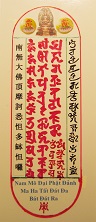 The Empty Tathāgata Treasury is wondrous beyond measure,
The Non-Empty Treasury nature transcends the work of transformation,
The Treasury that is neither empty nor non-empty is beyond words,
The ultimate meaning of the Middle Way is perfectly inclusive and harmonious.
In the Śūraṅgama Mantra, this is the first verse of the Fourth Assembly, the Vajra Treasury of Philosophical Assimilation.
“Bà già phạm” means Tathāgata. In this mantra phrase there are two characters “Đát”; the first is pronounced “đãn,” the second “đáp.”
“Tát” means “empty.”
“Bác” means “non-empty.”
“Đát Ra” means “treasury nature.”
This phrase “Bà già phạm tát đát đa bác đát ra” encompasses the Empty Tathāgata Treasury, the Non-Empty Tathāgata Treasury, and the Treasury that is neither empty nor non-empty. What is called the Empty Tathāgata Treasury? It means that all things are empty. The Non-Empty Tathāgata Treasury means existence. The Treasury that is neither empty nor non-empty means the Middle Way; it neither falls into emptiness nor clings to existence, but is the ultimate meaning of the Middle Way.
“The Empty Tathāgata Treasury is wondrous beyond measure”: the wondrous meaning within the Empty Tathāgata Treasury is boundless and inexhaustible; there is no way to fully express it.
“The Non-Empty Treasury nature transcends the work of transformation”: the nature of the Non-Empty Tathāgata Treasury surpasses the inconceivable functions of creation and transformation.
“The Treasury that is neither empty nor non-empty is beyond words”: the ultimate meaning of the Middle Way is beyond speech; there is nothing that can be said about it.
“The ultimate meaning of the Middle Way is perfectly inclusive and harmonious”: this is the ultimate destination of the Middle Way’s complete meaning. In summary, this is the great dhāraṇī, the spiritually efficacious text that is perfectly integrated and unobstructed. If one continually recites this mantra, one will illuminate the mind, see one’s true nature, subdue celestial demons, and restrain heterodox paths—depending on whether one can truly apply it.
Within the Tathāgata Treasury, even the Six Pāramitās are empty. Here we are discussing the emptiness of the Tathāgata Treasury. To describe its emptiness, the word “empty” must be used, but this is not complete negation. Something still exists within it: the fundamentally wondrous and perfectly complete mind. Yet that mind is not called by that name. Thus the Empty Tathāgata Treasury has already been described.
“And so on” refers to the levels of enlightenment, from the Six Pāramitās to the Ten Abodes, Ten Faiths, Ten Practices, Ten Dedications, and Ten Grounds; even Buddhahood itself is included within the Empty Tathāgata Treasury. From the stages of Bodhisattvas to the fruition of Buddhahood requires immense time and countless practices, yet all of it is empty; even Buddhahood is empty.
“Not the Tathāgata.” Even the title Tathāgata is empty. “Not an Arhat, not Right and Universal Knowledge.” Even the titles Worthy of Offerings and Right and Universal Knowledge are empty. Right Knowledge means knowing that the mind encompasses all dharmas. Knowing that all dharmas are only mind is Universal Knowledge. Right Knowledge is true wisdom that clearly reveals the principle. Universal Knowledge is expedient wisdom that illuminates phenomena. “Not the Great Nirvāṇa.” Even the notion of non-arising and non-ceasing is empty.
“There is no permanence, bliss, self, or purity.” “Permanence” means unmoving and unchanging. “Bliss” means being filled with the joy of the wondrous Dharma. “Self” means attaining the true self. “Purity” is the intrinsic characteristic of Nirvāṇa. These names, too, do not exist. It is entirely empty.
You may ask, then, what exists within the Tathāgata Treasury? I have already told you that all dharmas still exist there. If you ask what does not exist there, then nothing exists there. Everything arises from mind. The Tathāgata Treasury is empty, non-empty, empty and non-empty. Its subtle wonder is inexhaustible. You may say that all dharmas exist, then say that all dharmas are empty, and then say that all dharmas are both empty and non-empty. Only after a long period of deeply entering the Buddhadharma can one understand this. This is precisely the Empty Tathāgata Treasury. Therefore it is neither worldly nor transcendental dharmas. The Tathāgata Treasury is empty. Within it there is no dharma.
The Tathāgata Treasury is the fundamentally wondrous and perfectly complete mind. It is not your discriminating consciousness, nor is it mere emptiness. It is earth, water, fire, and wind. It is eye, ear, nose, tongue, body, and mind. It is form, sound, smell, taste, touch, and dharmas. It is the realm of visual consciousness all the way through to the realm of mental consciousness. Therefore the Empty Tathāgata Treasury is also the Non-Empty Tathāgata Treasury; the Tathāgata Treasury is not empty at all. Thus, within the Tathāgata Treasury, emptiness and non-emptiness are originally one; it is the primordial luminous and wondrous mind. It is the Five Aggregates, the Six Entrances, the Twelve Sense Bases, and the Eighteen Realms.
Previously, the Empty Tathāgata Treasury was explained. Now the Non-Empty Tathāgata Treasury is being discussed. If the Tathāgata Treasury is originally empty, why is it now called non-empty? Once it is empty, how can it also be non-empty? If the Tathāgata Treasury were merely empty, or if everything were simply contained within it, there would be nothing wondrous about it. But because wondrous existence arises from true emptiness, and true emptiness emerges from wondrous existence, the Tathāgata Treasury, though originally empty, gives rise to wondrous existence. Therefore the Five Aggregates, Six Entrances, Twelve Sense Bases, Eighteen Realms, Four Noble Truths, Twelve Links of Dependent Origination, and so forth—none of them are absent. They can be both empty and non-empty because they are indeterminate dharmas.
If you have not yet understood the meaning of the Tathāgata Treasury Nature, it is because you are attached to dharmas; in that case, you are one who clings to dharmas. If you are bound by dharmas, it is the same as not understanding them. Originally you were attached to a self, but after studying Buddhadharma you become attached to dharmas. Therefore, in Buddhism, one should not carry any attachment whatsoever. If you are attached to nothing, the non-empty is the empty. If you still cling, then emptiness becomes existence.
Apart from the meanings of “is,” apart from “exists,” and apart from “is not,” “does not exist.” It is neither existent nor nonexistent. This is true emptiness and wondrous existence. Therefore, the principle of the Tathāgata Treasury is that it is empty yet non-empty; it transcends both emptiness and non-emptiness, yet is not separate from emptiness and non-emptiness.