Dharma Body Vairocana Buddha
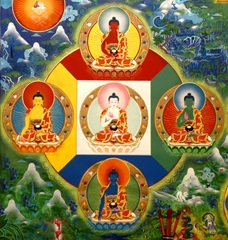 The Buddha has three bodies: the Dharma Body, the Reward Body, and the Emanation Body.
– The Dharma Body is the Pure Dharma Body Vairocana Buddha.
– The Reward Body is the Perfect Reward Body Rocana Buddha.
– The Emanation Body is the Hundred Thousand Million Transformation Bodies of Śākyamuni Buddha.
The Śākyamuni Buddha whom we read about in the sutras and whose statue is worshiped in temples is one of those hundred thousand million transformation bodies of Śākyamuni Buddha. He is also called the Seventh Ancient Buddha, or the last of the seven Buddhas of the past. These seven Buddhas are Vipassī, Sikhī, Vessabhū, Krakucchanda, Kanakamuni, Kāśyapa, and Śākyamuni.
Because he wished to teach and transform sentient beings, enabling all beings to attain Buddhahood, he descended into the Sahā World. It was not because the Buddha had not yet attained enlightenment, but because of sentient beings that he aroused the Bodhi mind, causing all beings to realize Anuttara-samyak-saṃbodhi (unsurpassed, complete, and perfect enlightenment).
After Śākyamuni Buddha attained enlightenment beneath the Bodhi tree, for the following twenty-one days his physical body remained seated there. Using his spiritual powers, the Buddha traveled everywhere—descending to the Dragon Palace, ascending to the heavenly realms, and even going into the future to the Jeta Grove—to preach the Dharma. Therefore, in the Avataṃsaka Sutra, his title is recorded as the Dharma Body Buddha, or the Pure Dharma Body Vairocana Buddha.
Vairocana means “pervading all places” and refers to the Buddha’s pure Dharma Body. This Buddha constantly turns the wheel of Dharma throughout all Buddha realms and the entire Dharma Realm. The Buddha’s Dharma Body is like clouds that extend everywhere. His wisdom is like the vast ocean. Vairocana Buddha, as the Pure Dharma Body, is present everywhere. His vows are the greatest, and there is no place where their power is not fulfilled. Not only does he manifest in this Sahā World, but throughout all worlds he continually turns the unsurpassed wheel of wonderful Dharma, constantly expounding the sublime teaching and teaching sentient beings throughout the ten directions.
Vairocana Buddha takes Dharma as his body. The pure Dharma Body is like empty space, yet within that space all phenomena appear. Within space, all forms arise, allowing all sentient beings to enter that Dharma essence and attain the Pure Dharma Body, the Perfect Reward Body, and the Hundred Thousand Million Transformation Bodies. Vairocana also means “light shining everywhere,” illuminating all places. He is nowhere and yet nowhere absent; throughout the entirety of space and the Dharma Realm there is only pure light.
Therefore, in the Prajñā Sutra, the Buddha said:
> If one sees me through form,
> Or seeks me through sound,
> That person practices a mistaken path
> And cannot see the Tathāgata.
“If one sees me through form” means seeing the Tathāgata through the thirty-two marks. On this point, the Avataṃsaka Sutra says: “The responsive and transformed body is not the true Buddha.” The Emanation Body and Transformation Body are not the true Buddha. The thirty-two marks belong to the responsive and transformation body, not to the Pure Dharma Body. The thirty-two marks are forms and appearances. To recognize the Tathāgata through these marks is the meaning of “If one sees me through form.” “Or seeks me through sound” means seeking the Buddha through his voice. The Buddha possesses “four unobstructed eloquences and eight beautiful sounds.” Such a person clings to appearances and becomes attached to conditioned phenomena, failing to accord with the Middle Way. Therefore, they cannot recognize the Tathāgata. The Tathāgata belongs to the Middle Way—neither leaning to one side nor the other, neither falling into emptiness nor becoming attached to existence, neither holding annihilationism nor eternalism. Those on mistaken paths either fall into annihilationism or become attached to eternalism. Both are extreme views and do not accord with the Middle Way. Therefore, they “cannot see the Tathāgata” and will never see the Buddha’s Pure Dharma Body.
The Buddha feared that people would become doubtful and attached to appearances, thinking that the Tathāgata truly comes and goes, so he taught this passage. The Buddha said: “If someone has vague thoughts that the Tathāgata comes, goes, sits, or lies down, then that person has not understood the meaning of the Tathāgata’s teaching.”
Why?
Because the Tathāgata comes from nowhere and goes nowhere; therefore he is called the Tathāgata.
The Buddha explained: “Why is this so? The Tathāgata does not come from any particular place, nor does he go to any other place. Therefore he is called the Tathāgata.”
We should understand that the Buddha’s Dharma Body is “nowhere located, yet nowhere absent,” because it pervades all places. If it already pervades all places, how can one say the Buddha comes? From where would he come? If one says the Buddha goes, where could he go? If we understand the Buddhadharma, then all rivers, mountains, and lands are the Buddha’s Dharma Body. If we do not understand the Buddhadharma, even if we see the Tathāgata we will not recognize him. Knowing how to recognize the Tathāgata makes cultivation easier; not knowing makes practice very difficult. Cultivating in confusion is like asking a blind person to guide the way.
What does it mean to follow a blind person? It is like someone without eyes following another person without eyes. They wander back and forth until they eventually fall into the sea and drown. The less we understand, the farther we move from the goal. Once we understand, reaching the goal becomes easy. Understanding the Buddhadharma and practicing accordingly leads to Buddhahood. Following non-Buddhist paths takes one farther and farther away, making it difficult to turn back. In the end, one may never return to the source. This is extremely dangerous.
As for the word “Tathāgata,” “Tathā” means unmoving, while “gata” implies movement. The unmoving is stillness; movement is activity. Movement and stillness are one. Movement does not obstruct stillness, and stillness does not obstruct movement. Cultivation is like this: when sitting quietly, one practices meditation; when moving, one also practices meditation. From morning until night, in every action—walking, standing, sitting, and lying down—one should cultivate diligently. Practice is not limited to formal meditation sessions. At all times, practitioners must gather their minds, constantly reflect inwardly, and not allow thoughts to wander. This is how one should cultivate.
Anyone who harbors doubts does so because of attachment in their own mind, not because the Buddha actually comes and goes. It is the person’s own mind that comes and goes. Consider the expression “the moon appears in clear water.” When the water is still and clear, the moon is reflected in it. Or “clouds cover the moon.” When clouds fill the sky, the moon is hidden. Now ask yourself: when “the moon appears in clear water,” does the moon actually come? When “clouds cover the moon,” does the moon actually go?
Likewise, some people see clouds moving across the sky and think the moon is moving. Others sit in a boat and, not realizing the boat is drifting, think the trees on the shore are moving. Because the Buddha manifests transformation bodies, people perceive coming and going. But the Pure Dharma Body Vairocana Buddha neither comes nor goes. This teaching concerns the Buddha’s Dharma Body; do not confuse the Dharma Body with the Transformation Body.
> The transformation body Buddha comes and goes,
> The Tathāgata is eternally unmoving.
> Within the Dharma Realm,
> Neither one nor many.
The verse means that the Buddha’s transformation body comes and goes, while the Tathāgata remains forever unmoving. Within the Dharma Realm, there is neither absolute unity nor multiplicity. We should understand this clearly: the Tathāgata neither comes nor goes. Yet within our eight consciousnesses there is the perceiving aspect. Our distinction between the Tathāgata’s coming and going arises from this perceiving aspect. Why does the sutra teach us not to think of the Buddha as coming, going, sitting, or lying down? Because it wants us to stop generating discriminating thoughts. If we can eliminate the discriminating mind, Prajñā wisdom will manifest. The reason so little Prajñā wisdom appears in us is that our discriminating mind occupies all the space, leaving no room for wisdom to emerge.
The eight consciousnesses are originally pure, but because they contain discriminating thoughts, they become defiled. If we can eliminate discrimination, like sweeping away garbage, everything will return to purity and wisdom will manifest.
Homage to the Pure Dharma Body Vairocana Buddha.
Homage to the Fundamental Teacher Śākyamuni Buddha.