The Pure Land of Eternal Quiescent Light
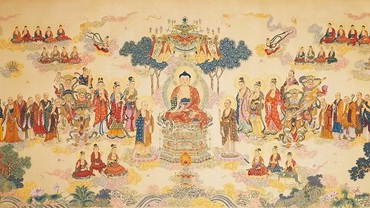 After the Buddha entered Nirvana, in which realm does the Buddha reside?
“Nir” means unborn; “vana” means undying. Entering Nirvana is also reaching the Pure Land of Eternal Quiescent Light (Changji Guang). The realm where Buddhas abide is the Eternal Quiescent Light World, also called the Pure Land of Eternal Quiescent Light. This Pure Land is unborn and undying, neither increasing nor decreasing, neither defiled nor pure; it is the dwelling place of all Buddhas.
In the Land of Ultimate Bliss (Sukhavati), there are four realms:
– The Realm Where Ordinary Beings and Saints Dwell Together (the Sahā World) is the world we currently inhabit. In that world there are ordinary beings, sages, Buddhas, Bodhisattvas, Śrāvakas, and Pratyekabuddhas dwelling together; therefore it is also called a “settlement.”
– The Realm of Expedient Means with Residual Afflictions is the dwelling place of heavenly beings, practitioners of the Two Vehicles, and Arhats. Why is it called “expedient”? Because that place is also good, and remaining there is acceptable, but it is not ultimate Nirvana; it is only Nirvana with residue, and is therefore likened to a “town.”
The cause for attaining the Realm of Expedient Means with Residual Afflictions is the elimination of the Four Abiding Afflictions. Just as the Reward Realm mentioned earlier has as its cause the “practice of true Dharma,” we should pay special attention to this aspect of cultivating causes. What are the Four Abiding Afflictions? They are commonly called the afflictions of views and thoughts. Incorrect thinking is called thought-affliction; incorrect understanding is called view-affliction.
Here, view-affliction is considered one abiding ground. If one eliminates view-affliction, one has eliminated one of the Four Abiding Afflictions and attains the Śrāvaka fruit of Stream-Enterer (Srotāpanna).
Thought-afflictions are divided into three abiding grounds:
1. The Ground of Desire-Attachment: the nine grades of thought-affliction in the Desire Realm. If completely eliminated, one no longer returns to the Desire Realm and attains the second fruit.
2. The Ground of Form-Attachment: corresponding to the Form Realm. If completely eliminated, one reaches the fourth dhyāna and attains the third fruit.
3. The Ground of Formless-Attachment: corresponding to the Four Formless Heavens. If all thirty-six grades of these afflictions are eliminated, one attains Arhatship.
Therefore, the Lesser Vehicle eliminates thought-afflictions. In conventional practice, these thought-afflictions must be eliminated.
– The Realm of True Reward and Adorned Purity is the dwelling place of Bodhisattvas. Bodhisattvas there possess spiritual powers, travel throughout Buddha lands, and teach sentient beings. It is likened to a “nation.” When one truly abides in the Dharma of Non-Duality, one enters this realm and becomes a First-Abiding Bodhisattva of the Perfect Teaching. Such a Bodhisattva has entered the stage of seeing the Way in Mahāyāna. From that day onward, one begins to see the Way itself. What Way? Seeing that all dharmas are Suchness, seeing that essence and appearance are not two. Applied to Buddha-recitation, this is the beginning of attaining the concentration of Principle-One-Mindedness, resulting in rebirth in the Realm of True Reward and Adorned Purity in the Western Pure Land, with the highest grade of rebirth, where the lotus blossoms and one sees the Buddha.
– The Pure Land of Eternal Quiescent Light is where all Buddhas dwell. It is the root; the other three realms are manifestations. When cultivation is perfected, all ultimately return to the root, joining the Buddhas in the Pure Land of Eternal Quiescent Light.
“Eternal” refers to the Dharma Body.
“Quiescent” refers to Liberation.
“Light” refers to Prajñā (Wisdom).
“Eternal” means uninterrupted, everlasting, unchanging.
“Quiescent” means stillness. We speak of concentration; when concentration reaches its ultimate point it is called quiescent extinction. The Patience of Quiescent Extinction among the Five Patiences is the originally abiding self-nature, not something acquired through cultivation.
“Light” means radiance and also perfect wisdom.
Mahāyāna scriptures teach that these three terms constitute the “secret treasury of the three virtues”: Dharma Body, Prajñā, and Liberation.
Eternal Quiescent Light is the complete manifestation of the Three Virtues. “There is never a time when one does not go to the Pure Land of Ultimate Bliss.” Eternal Quiescent Light is the Land of Ultimate Bliss, and the Land of Ultimate Bliss is Eternal Quiescent Light.
These three qualities are fruits of realization, but now we must cultivate them. If cause and effect do not correspond, then no matter how hard one practices, one cannot enter that realm. Where should cultivation begin? It begins with concentration. Concentration is the key. If one attains even one of the three qualities of Eternal Quiescent Light, the other two follow. Among them, where should one start? With Quiescence. Quiescence is the “one-pointedness without confusion” spoken of in this sutra and the Buddha-recitation samādhi emphasized in the Pure Land tradition. This is the goal of Pure Land practitioners.
If our minds become increasingly pure year by year, then our practice is effective and proceeding correctly. Therefore, cause and effect must correspond.
Scripture: “Vairocana pervades all places. The dwelling place of that Buddha is called Eternal Quiescent Light.”
Translation: “Vairocana pervades all places. The dwelling place of that Buddha is called Eternal Quiescent Light,” which is the abode of the one who has attained the ultimate fruit.
Commentary: The Buddha teaches and transforms beings according to those who can be liberated, and therefore manifests different names in different places: Śākyamuni, Locana, or Vairocana. Although the names differ, they all refer to the same Buddha.
The Buddha told his disciples: “I will now enter Nirvana.” In truth, the Buddha neither arises nor ceases but always abides in the realm of Eternal Quiescent Light teaching the Dharma. Through countless skillful means he expounds inconceivable wondrous teachings, bringing joy to sentient beings.
The Buddha in the Pure Land of Eternal Quiescent Light emits immeasurable light illuminating the entire Dharma Realm. There is nowhere that light does not reach. Throughout space and the Dharma Realm, all is illuminated by the Buddha’s radiance.
“Ultimate fruit” means Buddhahood. Eternal Quiescent Light is what philosophy might call the fundamental reality underlying all existence. It is complete and perfect realization.
The Avataṃsaka Sutra teaches the Three Bodies of the Buddha:
– Vairocana is the Dharma Body Buddha.
– Locana is the Reward Body Buddha.
– Śākyamuni is the Manifestation Body Buddha.
Vairocana has two meanings: “Pervading All Places” and “Universal Illumination.” Ultimately these mean the same thing.
Throughout empty space and the Dharma Realm there is one fundamental reality. All phenomena arise from it. The scriptures often say:
“All Buddhas of the ten directions share one Dharma Body.”
Do we share that same Dharma Body? Certainly. All sentient beings, mountains, rivers, earth, and space arise from it. It is the true basis and essence of all phenomena.
In Pure Land teaching this is called Eternal Quiescent Light, meaning illumination pervading all beings, all lands, all time, and all space.
Why is it called Eternal Quiescent Light?
The Dharma Body Buddha has no form. What form could the Dharma Body have? The entire universe is its form. If one realizes that all space and the Dharma Realm are oneself, one has realized the Dharma Body.
One who realizes the Dharma Body possesses a pure and equal mind and knows that self and others are not two.
An analogy is a dream. Suppose within a dream you suddenly realize, “I am dreaming.” The self in the dream is created by your own mind. Everyone else in the dream is also created by your mind. Outside the mind there is no dream; outside the dream there is no mind. The entire dream realm—including mountains, rivers, earth, and sky—is yourself. Suddenly one awakens and realizes that the whole universe is oneself. Apart from oneself there is no other. This is called thoroughly awakening to the pure Dharma Body.
At that point one naturally gives rise to Great Compassion of Shared Essence and Unconditioned Great Loving-Kindness toward all beings. One’s mind becomes truly equal toward all because all are oneself.
Eternal Quiescent Light:
“Eternal” refers to the Dharma Body.
“Quiescent” refers to Liberation.
“Light” refers to Wisdom.
These are the three virtues of Nirvana.
The Dharma Body is one’s true body, never false. To realize it is to know that all adornments of dependent and direct retribution throughout the ten Dharma realms are oneself.
The Lotus Sutra calls this “entering the Buddha’s knowledge and vision.”
The first aspect, Eternal, is realization of ultimate reality. The second, Quiescence, is liberation and complete freedom. This freedom comes from quiescence—the extinguishing of discrimination, attachment, and deluded thought.
The Diamond Sutra speaks of the notions of self, person, sentient being, and lifespan. These arise from discrimination and attachment. When these cease, what remains? Reality is fundamentally one.
Thus, after realizing the Dharma Body, the world becomes the One True Dharma Realm. One is real; two is illusory.
Chan Buddhism says:
“If you know the One, all affairs are complete.”
To truly know the One—that all phenomena throughout the universe are fundamentally one—is the completion of the path. The highest realization in Buddhism is precisely this.
The appearance of the worlds in the ten directions is explained in Consciousness-Only teachings: “From ignorance and non-awakening arise the three subtle appearances.”
These are:
1. The Appearance of Ignorant Activity.
2. The Appearance of Transformation.
3. The Appearance of Objective Conditions.
The Pure Land of Ultimate Bliss is free from ignorance and therefore manifests directly from True Suchness.
The Buddha always abides in Eternal Quiescent Light, just as space is boundless. The Buddha’s Dharma Body is likewise boundless and present everywhere. According to the minds of beings, the Buddha manifests forms to liberate them. There is nowhere the Buddha does not go.
Thus, regardless of school or method, Buddhism places such importance on meditative concentration because concentration corresponds to Quiescence. Without concentration, how can one attain purity of mind? Yet not every form of concentration is ultimate Buddhism. There are worldly concentrations such as the Four Dhyānas and Eight Concentrations. There are also the Nine Successive Concentrations of the Lesser Vehicle. Mahāyāna has many forms of concentration as well. The complete and ultimate concentration is called the Śūraṅgama Samādhi in the Śūraṅgama Sutra and the Lion’s Roar Samādhi in the Avataṃsaka Sutra.
— oOo —
The Land of Ultimate Bliss
Among the four realms, practitioners of the Pure Land path are reborn in the Western Land of Ultimate Bliss. Initially they are born within lotus flowers. Though inside a lotus, that realm is vast beyond measure. The Land of Ultimate Bliss described in the Amitābha Sutra refers to the Realm Where Ordinary Beings and Saints Dwell Together, not the Realm of True Reward and Adorned Purity of the Bodhisattvas nor the Eternal Quiescent Light of the Buddhas. Why is it called a shared realm? Because beings who are reborn while still carrying karmic residues all enter this realm. This makes it especially accessible and intimate.
All Buddhas’ lands in the ten directions have four realms. Our current world is the shared realm of Śākyamuni Buddha. The Realm of Expedient Means and the Realm of True Reward in this Sahā World are not visible to us. The marvel of the Western Pure Land is that although one is reborn in the shared realm, it connects directly with the three higher realms. Thus rebirth there is called “horizontal transcendence.” One crosses beyond the Three Realms and enters all four Pure Land realms simultaneously. To be born in one realm is to participate in all. One can see Bodhisattvas, heavenly beings, and assemblies from the higher realms.
In the Western Pure Land, the ground is gold. In the Eastern Lapis Lazuli World, the ground is lapis lazuli. There is no dust, filth, hell, hungry ghosts, animals, or sounds of suffering. The phrase “Eastern Akṣobhya, Western Amitābha” refers to Akṣobhya Buddha (also associated with Medicine Buddha in this text) in the East and Amitābha Buddha in the West. Through the power of the Buddha’s great vows, the land enjoys peace, timely winds and rains, abundant harvests, and universal well-being.
The land is flat like the palm of a hand, golden in color, free from pits and thorns. The ground is soft like celestial cotton. When one walks, it gently yields and then returns to its original state. The inhabitants do not engage in trade or farming. They enjoy effortless abundance. There is no lying, no foul odors, and greed, hatred, and delusion are exceedingly weak. There are no prisons and no heterodox teachings. Food and drink appear according to thought. There is no impurity or bodily waste. Palaces are adorned with seven treasures. Bathing ponds filled with the waters of eight virtues are found everywhere. Beautiful gardens abound.
For practitioners, the Pure Land differs greatly from the Sahā World. In this world, a Stream-Enterer may require seven lifetimes before attaining Arhatship. In the Pure Land, hearing the Buddha’s teachings repeatedly can lead rapidly through the stages of realization. Although one is initially reborn in the shared realm, one enjoys conditions comparable to heavenly realms and the Realm of Expedient Means.
After a period of abiding joyfully within the lotus, one resumes cultivation and turns inward toward one’s own nature. “When the lotus opens, one sees the Buddha and realizes the unborn.” At that moment the lotus blossoms, and one enters the Bodhisattvas’ realm, the Realm of True Reward and Adorned Purity. “Unborn” means attaining the patience of the unborn Dharma and entering the Bodhisattva stage.
Some Buddhists fear that if they are reborn in the Pure Land, they will no longer be able to care for family members. However, upon reaching the Pure Land and receiving the Buddha’s inconceivable support, one can immediately return to the Sahā World to help relatives and loved ones. In truth, upon arriving in the Pure Land, one’s perspective expands to encompass the entire Dharma Realm. One discovers countless relatives and connections throughout the ten directions, not merely those in this world.
“Returning to the Sahā World” does not mean leaving the Buddha. The Buddha remains with you. One gains the ability to manifest countless forms throughout the ten directions, just as Avalokiteśvara Bodhisattva appears in whatever form is needed to liberate beings. The Lotus Sutra, in the chapter on the lifespan of the Tathāgata, states:
“Since I attained Buddhahood, an immeasurably long time has passed. My lifespan is countless asaṃkhyeya kalpas. I always abide and do not perish. Yet I declare that I will enter extinction as a skillful means to teach sentient beings.”
My studens: From the time I attained Buddhahood until now, countless immeasurable ages have passed. I always abide in the Pure Land of Eternal Quiescent Light. I neither arise nor cease. My enlightenment beneath the Bodhi tree and my passing between the twin sāla trees were merely skillful manifestations. For the sake of teaching sentient beings, I speak of entering Nirvana, though in reality I do not truly cease.
Since attaining Buddhahood,
The kalpas I have passed through
Are countless hundreds of thousands of millions
Of asaṃkhyeya ages.
I constantly teach and transform
Innumerable sentient beings,
Leading them to enter the Buddha Way.