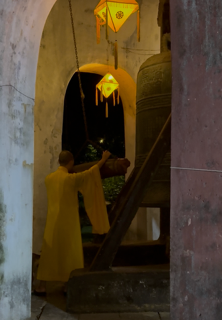
The Great Bell at Dieu De Pagoda
 “Dong Ba, Gia Hoi, two bridges
Pass by Dieu De, four floors, two bells.”
First of all, we would like to express our gratitude to the venerable monks at Dieu De Pagoda. During September 12 – 16, 2025, we had the opportunity to visit the pagoda for 4 days. These were also the days just before the floods and storms in the central region of our country.
Dieu De Pagoda was built during the early years of King Thieu Tri’s reign. Construction began in 1841 and was completed in 3 years. The Great Bell was ordered to be cast by King Thieu Tri at the end of 1845 and was completed in the summer of 1846. The inscription on the back of the bell reads: “Thieu Tri luc niem luc nguyet cat nhat tao”. It can be temporarily translated as: in the 6th year of King Thieu Tri’s reign, on an auspicious day in the 6th month (June 1846). The bell weighs 622 can, as stated in the inscription: “Trong luc bach nhi thap nhi can”. In addition, the back of the bell also bears 48 cast characters:
Homage to the Great Enlightened One
108 bell sounds
Resounding throughout the nine heavens
The ten Bodhisattva stages universally extending salvation
Spreading throughout all beings in the world
Helping them see through delusion and darkness
And return to wholesome thoughts
Saving sentient beings
Reborn in the Pure Land
Forever enjoying peace.
Mantra: “Om, gia ra de da, ta ba ha”
The final line is a mantra, or the True Words for Breaking Through the Hells. This is the mantra that the monks chant during the evening practice. “Gia ra de” means crossing beyond birth and death, crossing the sea of suffering of birth and death, and also means liberation. If you diligently practice and uphold this mudra, you can help wandering spirits cross beyond the sea of suffering and reach the shore of liberation.
In the Great Compassion Mantra there is also a phrase “Phat gia ra de”, associated with the hand-and-eye mudra practice, whose spiritual power is similar to the final phrase on the bell. Gia ra de, in Chinese interpretation, means vast and majestic. If you wish to use this mudra, first of all there must be solemnity and dignity in your practice. Another meaning of “Gia ra de” is vastness. This means that one must have a great and expansive compassionate heart. If one practices without solemnity and the heart is not expansive, how can one save sentient beings from the dark realms of hell.
“Ta ba ha” is translated as “accomplishment”. Accomplishment of what? Accomplishment of all the practitioner’s vows
Miraculous transformations, the foremost blessing
The golden staff saves the world
Sentient beings in hell receive its grace
Leaving all obstacles and calamities, giving rise to bodhicitta
During the nights when the Shurangama Mantra was chanted at 11 p.m. All the wandering spirits would gather at the pagoda, some came to seek merit, some came to listen to the Dharma, and some came simply because they saw the crowd and came. More than 10 dogs had spiritual eyes, so they could see the wandering spirits gathering, and therefore barked loudly and continuously for 1 hour. On this occasion, we also sincerely apologize for disturbing the monks and everyone living around the pagoda by causing the noise of the dogs barking. We sincerely repent
If any of you have the opportunity to visit Hue, remember to stop by Dieu De Pagoda. The pagoda is simple, but if you look carefully, you will see its elegance and peacefulness, as well as even a great history of our country.