Taking Refuge in the Three Jewels
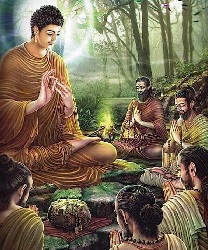 Taking Refuge in the Three Jewels means taking refuge in the Buddha, the Dharma, and the Sangha. What does taking refuge mean? Taking refuge means turning back and relying upon the Buddha, the Dharma, and the Sangha. Apart from the Buddha, the Dharma, and the Sangha, no one can save and protect us.?
All sentient beings who wish to seek unsurpassed Bodhi and the bliss of Nirvana need to turn back and rely upon the Three Jewels: the Buddha, the Dharma, and the Sangha. Through this, sentient beings are led to turn toward the Buddha, the Dharma, and the Sangha.
Taking Refuge in the Buddha
The Jewel of the Buddha has two aspects: the Buddha’s body and the Buddha’s virtues.
The Buddha’s body means the Tathagata, Worthy of Offerings, Perfectly and Completely Enlightened, Perfect in Knowledge and Conduct, Well Gone, Knower of the World, Unsurpassed One, Tamer of Men, Teacher of Gods and Humans, Buddha, World-Honored One. In the past, having passed through immeasurable, boundless asamkhyeya kalpas, without sparing body or life, diligently cultivating the six perfections and myriad practices to perfection, sitting upon the Vajra Seat beneath the Bodhi tree, conquering the armies of Mara, severing all fetters, realizing Omniscience, attaining Perfect Enlightenment, and possessing such complete and wondrous virtues, he is therefore called the Buddha.
The virtues of the Buddha mean that within the Buddha’s body are fully present the Ten Powers, the Four Fearlessnesses, the Eighteen Unshared Dharmas, great Loving-kindness, great Compassion, great Joy, great Equanimity, the three liberation gates, the three modes of manifestation, the six supernatural powers, the Samadhi of following the mind, the four wisdoms, the two wisdoms, freedom from views and knowledge, the severing of the afflictive obscurations and the obscurations of knowledge, freedom from all habitual tendencies, and the effortless path, while nevertheless manifesting transformations such as they are. Whether far or near, he moves and stands freely without obstruction. A mustard seed can contain immeasurable Mount Sumerus. All Buddhas and Tathagatas fully possess immeasurable, boundless virtues such as these. Their lifespans are freely extended from one kalpa to immeasurable kalpas without diminution, and within the realm of miraculous manifestations, they come and go freely according to their wishes without any obstruction. When the Buddhas, the World-Honored Ones, pass through cities, towns, and villages, they first radiate wondrous, brilliant golden light throughout those places. Sentient beings there who encounter this light, if they have bodily illness or mental illness, are all healed. When the fire of the mind is extinguished, the body becomes cool; those with hunched backs become straight, the lame can walk, the blind can see, the deaf can hear, the mute can speak, those with disturbed minds become calm, and those seized by demons, spirits, and mad delusions are all freed. The naked are clothed, the arrogant become humble, the sorrowful become peaceful, those who have lost their way find the right path, the hungry and thirsty receive food and drink, those imprisoned are freed, and the fearful become fearless; mounds, pits, hills, and mountains all become level like the palm of a hand. Small, low houses naturally become tall and spacious, and narrow roads all become broad. Markets and villages naturally open up and become accessible, and filth and impurity instantly become fragrant. Thorns, poisonous mosquitoes, bricks and tiles, sand and stones all disappear. The sunlight shines without scorching heat. A gentle breeze blows without raising dust, and the sounds of birds: white cranes, peacocks, parrots, saris, kalavinkas, kajilas, kanalas, jivajivas… are melodious. Elephants, horses, buffaloes, goats, cows, long-tailed cattle, wild buffaloes, water buffaloes, each species makes very beautiful sounds; zithers, flutes, pipes, stringed instruments, drums… these musical instruments sound without being played, and other exquisite and rare things all arise through miraculous transformation. Such rare phenomena become increasingly wondrous and excellent day by day, all through the majestic spiritual power of the Tathagata. If there are any sentient beings who doubt the Buddha, the World-Honored One, and whether the Buddha’s virtues are one or different, one should tell them:
The Buddha’s body and the Buddha’s virtues – neither one nor different. Just as fire, a lamp, oil, a wick, and light are neither one nor different. If oil and the wick are separated, there is no light from the lamp. If one says that the lamp’s light is separate from the oil and wick, then wherever the light shines, it should be burned. The virtues and the Buddha’s body are likewise. This wondrous body is the Buddha’s virtue, the undefiled Dharma body, the equal refuge of oneself and others. Yet this Buddha body is not the essential nature. If this essential nature is separated, there is no other Dharma body apart from it. If this essential nature were identical with external things, it would have the characteristics of the four great elements, and therefore one should know that the Buddha’s body is neither characterized nor uncharacterized. If it were uncharacterized, it would be identical with great emptiness; being identical with great emptiness, its nature would be eternal, and there would be no means by which anything could pass through it. Its self-nature is originally pure, undefiled, unattached, profound and immeasurable, never changing, wondrously tranquil, difficult to understand, difficult to compare. It fully possesses true and eternal virtues without limitation, completely ends all conceptual elaborations, and only the Buddha can directly know it; no one else can know it, nor can any analogy compare with it.
The Three Bodies of the Buddha – namely the Dharma Body, the Sambhogakaya, and the Nirmanakaya
This body is the Dharma-body aspect of the Buddhas of the past, present, and future, as numerous as the sands of the Ganges.
The Buddha’s Sambhogakaya means that the Tathagatas, having cultivated immeasurable accumulations of merit and wisdom over three countless kalpas, attained boundless true virtues; their auspicious marks and faculties are permanently abiding and unchanging, their radiant wisdom pervades the entire Dharma realm, and all arise from undefiled, supramundane roots of goodness. It is inconceivable and surpasses worldly wisdom; in order to mature sentient beings, this form manifests to expound the inexhaustible Dharma and bring boundless benefit. Maitreya, you should know! This is the Tathagata’s perfect Sambhogakaya.
The Nirmanakaya manifests according to sentient beings, appearing as immeasurable and innumerable transformed Buddha bodies. That transformed body may appear in hell, manifesting a hell-being body to liberate the sentient beings there from suffering, using the True Dharma to guide them to arouse the mind of Bodhi, after which they are born in the realms of gods and humans, enjoying supreme happiness, developing deep faith and delight in the Buddha Dharma, realizing portions of the Buddha Dharma, and attaining the fruits of the Noble Path. Or it may be born among hungry ghosts to teach and transform the sentient beings there, enabling them to escape the torment of hunger and thirst, using the True Dharma to teach them so that they arouse the mind of Bodhi, whereupon they are born in the realms of gods and humans, enjoying happiness, deeply entering the Buddha Dharma, and realizing the fruits of the Noble Path. Or it may transform into an animal, being born in that realm, or take the body of a Garuda, or the body of a dragon, lion, elephant, horse, bear, tiger, wolf, jackal, fox, hare, python, snake, fish, turtle, softshell turtle, white crane, peacock, phoenix, mandarin duck, parrot, sari… and many other bodies, causing those sentient beings to abandon harming one another and instead develop Loving-kindness and Compassion toward one another, thereby leaving behind all fear. The True Dharma is used to instruct them to have faith and delight and to turn back and rely upon the Buddha, the Dharma, and the Sangha, whereby they are born in the realms of gods and humans, enjoy happiness, attain portions of the Buddha Dharma, and realize the fruits of the Noble Path.
All such immeasurable, boundless skillful means are due to the Tathagata’s sovereign miraculous power. Thus, the essence of the three bodies has no distinguishing characteristics. Why must we make the vow to take refuge in the Buddha? Because the Buddha’s Transformation Body changes in only an instant. The Buddha’s manifested body quickly enters Nirvana. But the virtues of the Dharma Body remain eternally abiding as before, and therefore one takes refuge in the pure Dharma Body. Taking refuge in the Dharma Body means taking refuge in all Buddhas of the past, future, and present. If we abandon sentient beings and seek Nirvana, then we will share the sufferings of the hells. If we liberate sentient beings together, then even while in hell it is no different from being in Nirvana. For this reason, sentient beings are led to take refuge in the Buddha, the Dharma, and the Sangha, to realize the bliss of Nirvana, with the ultimate essential nature remaining thusness, neither increasing nor decreasing. Such a Dharma Body is true bliss, and therefore they are guided to take refuge in the Buddha’s Dharma Body.
Any good man or good woman who takes refuge in the Buddha must take refuge in the Tathagata’s pure Dharma Body. If one wishes to seek the Buddha’s Dharma Body, one should make the great vow: May I and all those sentient beings attain the virtues of such a Dharma Body?
Taking Refuge in the Dharma
Taking refuge in the Dharma means taking refuge in the three Dharma Jewels:
The pure Dharma Jewel, or the Dharma Jewel of liberation of the Great Prajñāpāramitā
The second Dharma Jewel is the wondrous superior virtues of morality, concentration, and wisdom.
The third Dharma Jewel is the True Dharma that the countless Buddhas and World-Honored Ones of the past have taught
1. Why is it called the pure Dharma Jewel? The Dharma Jewel also has three categories: The Dharma Jewel means the ambrosial Nirvana of liberation, taking permanence, bliss, self, and purity as its essential nature, completely eliminating all birth, aging, sickness, death, sorrow, and suffering.
Why is birth called suffering? It means that when the father and mother unite, the impure seed is in the mother’s womb, sustained by the wind of karmic force, passing nine months in a dark place without light, living in an unclean and impure womb, where eighty thousand kinds of worms intermingle, breathing in and out according to the mother, unable to eat with the mouth, unable to see with the eyes, suffering hunger and thirst, cold and heat, with suffering tormenting body and mind… Countless sufferings such as these deprive sentient beings of freedom, and therefore this is called the suffering of birth. Although afflicted by this suffering, there is one virtue in that all enemies cannot see, nor can they speak of what is right or wrong, good or evil, yet it cannot in any way compare with the bliss of Nirvana, because in this Dharma there is no such suffering.
Why is aging called suffering? It means that sentient beings change over time from childhood to old age; whenever there is fullness, there is inevitably decline, the sinews and strength deteriorate, walking and standing become trembling, the hair turns white, the face wrinkles, the ears and eyes become dim, the teeth fall out, the appearance becomes ugly, the body becomes feeble, and one is despised and disliked by others. Whatever one says is immediately forgotten, and one carries that body as though bearing a heavy burden. Like a lamp that is about to run out of oil, it will soon go out, so too with an old person, when strength is nearly exhausted, death will soon come. Just as a mask covers the entire face, causing sentient beings, upon seeing it, to develop the mind to mock the mask; aging is likewise, from one village to another, all sentient beings wear the hat of decline and old age, and everyone who sees it mocks it. Because of this cause and condition, one undergoes suffering and distress. When death draws near, there is no medicine to cure it. Although suffering from pain, one does not become weary of it, but instead prays to miraculous spirits, hoping to live longer. Nothing compares with the bliss of Nirvana, and in the Dharma of Nirvana there is no such suffering of old age.
Why is sickness called suffering? It means that earth, water, fire, and wind oppose one another, and all kinds of suffering and distress converge upon and afflict the body. All sentient beings, young and old alike, share this sickness. Relatives, family, gold and silver, pearls, and the five wondrous desires that bring comfort and satisfaction to the body must all be left behind. Even if one instructs one’s children and relatives, they do not listen, and all enemies and deceitful people come to one’s side. No one desires such suffering from sickness, so one should know that sickness is great suffering. In the blissful Dharma of Nirvana, nothing compares with it, it is pure and tranquil, and there is no such suffering of sickness.
Why is death called suffering? It means that when sentient beings stop breathing and consciousness disappears, they no longer know anything. Of all suffering, nothing surpasses the suffering of death. The suffering of birth, aging, and sickness in the five realms may or may not occur, and is not certain, but the suffering of death is shared by all. For example, the suffering of poverty can be overcome by seeking prosperity, the suffering of enmity can be transformed through love, but when the suffering of death comes, whether old or young, foolish or wise, noble or lowly… all must leave everything behind. After abandoning this body and entering a dark place, clothing, bedding… and all possessions are of no use, one goes naked, without friends or wealth, unable to avoid separation, and even crying out is useless. Alas! Can impermanence bring such danger! Rich or rustic, it does not choose the body; enemy. No sentient being in the three realms can escape it, all are punished by death, so how could it possibly be prevented! Even if there were a Wheel-Turning King, or the strength of Nārāyaṇa, they would all be captured alive. Therefore, one should know that the suffering of death is immeasurable and boundless. Contemplating it in this way, death is great suffering.
Taking refuge in the Dharma means attaining within the Dharma of Nirvana liberation, tranquility, and bliss, where such suffering does not exist at all. It is like someone drowning in the waves of the sea who is rescued and brought up onto a high mountain, where there is no longer anything to fear. Sentient beings are likewise constantly submerged in the fierce current of birth and death; upon reaching the mountain of Nirvana, they are freed from the fear of birth and death. Just as rain washes away the obstacles of heat, dust, and filth, bringing everyone joy, cooling body and mind, causing all trees and grasses to flourish and yielding abundant flowers and fruits. The Dharma rain of the Tathagata is likewise, eliminating all afflictions and oppression, making sentient beings cool, joyful, and liberated, causing all pure wholesome roots to develop, accomplishing the path and attaining Nirvana. Because of this cause and condition, the Buddhas and World-Honored Ones relinquish the impermanent body and attain Nirvana.
That is the first Dharma Jewel, the Dharma Jewel of liberation of the Great Prajñāpāramitā.
2. The second Dharma Jewel refers to the sublime merits of morality, concentration, and wisdom. These are the thirty-seven factors of enlightenment: the four foundations of mindfulness, the four right efforts, the four bases of spiritual power, the five faculties, the five powers, the seven factors of enlightenment, and the Noble Eightfold Path. These thirty-seven practices are the means to the pure Dharma Jewel mentioned above. What are means? It means that by cultivating these practices, one realizes that pure Dharma Body?
3 . What is the third Dharma Jewel? It means the Right Dharma that the countless Buddhas and World-Honored Ones of the past have taught, which I now teach in the same way. That Right Dharma consists of eighty-four thousand wondrous Dharma aggregates that tame and mature sentient beings who have affinities, causing great disciples such as Ānanda… to remember immediately whatever enters their ears, and to preserve and classify it into five divisions:
- Sūtra (Sūtra) – For sentient beings who delight in dwelling in mountains and forests, in secluded places practicing meditation, teach them the Sūtra division.
- Vinaya (Discipline) – For sentient beings who delight in learning dignified conduct, protecting and harmoniously preserving the Right Dharma so that the Right Dharma may abide for a long time, teach them the Vinaya division.
- Abhidharma (Treatise) – For sentient beings who delight in discussing the Right Dharma, distinguishing the nature and characteristics of phenomena, successively investigating profound and subtle doctrinal meanings, ultimately teach them the Abhidharma division.
- Prajñāpāramitā – For sentient beings who delight in learning the true wisdom of Mahāyāna, free from all discrimination and attachment to self and phenomena, teach them the Prajñāpāramitā division.
- Dhāraṇī Gate – For sentient beings who are unable to retain the Sūtras, Vinaya, Treatises, and Prajñā, or for sentient beings who have committed the four grave offenses, the eight grave offenses, the five heinous crimes, slandered the Vaipulya sūtras, or are icchantikas… and have committed grave offenses, wishing them to have those offenses eradicated and to quickly attain liberation, awakening, and Nirvāṇa, the Dhāraṇī division should be taught to them.
These five divisions of Dharma are like milk, butter, raw butter, clarified butter, and ghee. The Sūtras are like milk; the Vinaya like butter, the Treatises like raw butter; Mahāyāna Prajñā like clarified butter; the Dhāraṇī, or Dhāraṇī Gate, like ghee. Among milk, butter, and oil, the flavor of ghee is the most sublime; because it can eliminate diseases, causing the bodies and minds of sentient beings to be peaceful and joyful. Among the Sūtras, the Dhāraṇī Gate is supreme, able to eliminate grave offenses so that sentient beings may be liberated from birth and death and quickly realize the blissful Dharma Body of Nirvāṇa.
Taking Refuge in the Sangha
The Sangha Jewel also has three:
- The Sangha of Ultimate Meaning
- The Noble Sangha
- The Sangha as Field of Merit
The Sangha of Ultimate Meaning: this means that Buddhas and noble Sangha members abide in accordance with the Dharma, cannot be seen, cannot be grasped, cannot be destroyed, cannot be burned, cannot be conceived of, and are the auspicious field of merit for all sentient beings. Although it is a field of merit, there is nothing to receive and nothing to take, because the meritorious Dharma is eternal and unchanging. This is the meaning of the first Sangha.
The Noble Sangha: this means those practicing toward Stream-entry and the fruit of Stream-entry, practicing toward Once-returning and the fruit of Once-returning, practicing toward Non-returning and the fruit of Non-returning, practicing toward Arhatship and the fruit of Arhatship, practicing toward Pratyekabuddhahood and the fruit of Pratyekabuddhahood, the Eight Great Persons of Awakening, the three Worthies, and the ten Noble Ones. This is the second Sangha Jewel.
The Sangha as Field of Merit: this means Bhikṣus and Bhikṣuṇīs who uphold the precepts, possess extensive learning and wisdom, like the Heavenly-Wish-Fulfilling Tree that provides shade for sentient beings. It is like traveling through a desolate desert, when, while thirsty and searching for water, one suddenly encounters sweet dew from heaven pouring down in time, making one fully satisfied, like all precious jewels arising from the great ocean. The Sangha Jewel as a field of merit is likewise able to bring safety and joy to sentient beings. This Sangha Jewel is pure and undefiled, able to eliminate greed, anger, and delusion in sentient beings. Like the full moon shining brilliantly on the night of the full moon, all sentient beings gaze upon it. Like the maṇi jewel fulfilling the wholesome wishes of all sentient beings. This is called the third Sangha Jewel. These are the three Sangha Jewels.
How should all sentient beings take refuge in these three meanings of the Sangha Jewel? They should be taught in this way so that they take refuge in the unconditioned Sangha, the ultimate truth. Why is this so? Because the unconditioned is the eternally abiding Sangha, and this Sangha Jewel is undefiled and unconditioned, a Dharma realized by oneself, without change or difference. Taking refuge in such an undefiled Sangha Jewel can eliminate all suffering and calamities for sentient beings. May sentient beings also attain such undefiled merits. Having attained this Dharma, they should expound the Dharma of the three vehicles to liberate sentient beings.
Taking Refuge in the Three Jewels
If there are any sentient beings who take refuge in the Three Jewels, they should arouse the mind in this way: I have now attained this body and been born in the human realm, thus gaining freedom from the eight difficulties; what is difficult to attain has been attained. I shall use this favorable opportunity to learn all wondrous and supreme Dharma. If I go against the vow above and do not seek wholesome Dharma, I am deceiving myself.
When strong faith has arisen, then before the Buddha, uncover the right shoulder, kneel with palms joined, and ask to take refuge in the Buddha, Dharma, and Sangha Jewels. It is like a poor person in the world who is despised, beaten, ordered about, scolded, and insulted by everyone. After being despised, that person seeks out someone noble and powerful to become their master, and thus will avoid such contempt and insults.
Sentient beings are likewise. Whether born in the evil realms or the human realm, they are constantly tormented by suffering. Wishing to escape suffering, if they take refuge in the Three Jewels, those sufferings will all be extinguished. Having taken refuge in the Three Jewels, they should then make the vow: I vow to rescue all sentient beings and help them cross the sea of birth and death to reach the other shore of Nirvana?
Those who arouse the aspiration to practice the Mahayana path should take refuge in the Three Jewels in this way.
One who takes refuge in the Buddha
Is truly called an Upasaka
Never taking refuge
In any other god or deity.
One who takes refuge in the Dharma
Abandons the taking of life
One who takes refuge in the Noble Sangha
Does not seek out other non-Buddhist paths
Taking refuge in the Three Jewels in this way
One will become free from fear.