The Four Dhyanas and Eight Concentrations
In the world, meditative concentration is generally referred to as the Four Dhyanas and Eight Concentrations. The four types of concentration in the Four Dhyana Heavens, together with the four types of concentration in the Four Formless Heavens, make up the Eight Concentrations. In reality, the Four Dhyanas and Eight Concentrations are the Eight Concentrations; there are not eight additional concentrations beyond the Four Dhyanas. The Four Dhyanas and Eight Concentrations are:
-
The sequential concentration of the First Dhyana.
-
The sequential concentration of the Second Dhyana.
-
The sequential concentration of the Third Dhyana.
-
The sequential concentration of the Fourth Dhyana.
-
The sequential concentration of the Sphere of Infinite Space.
-
The sequential concentration of the Sphere of Infinite Consciousness.
-
The sequential concentration of the Sphere of Nothingness.
-
The sequential concentration of the Sphere of Neither Perception nor Non-Perception.
These are worldly meditative concentrations. Although the Four Dhyanas and Eight Concentrations cannot free one from the Three Realms, they can still free one from certain worldly bonds. The Four Dhyanas (from the First through the Fourth Dhyana) free one from the bonds of material form:
-
Liberation through contemplating external forms while internally perceiving forms.
-
Liberation through contemplating external forms while internally perceiving no forms.
-
Pure liberation, directly realized through the body and fully established.
Those who attain the Four Dhyanas are reborn in the Heaven of Abundant Birth or the Heaven of Abundant Love. From the Fourth Dhyana, there are two possible paths. If they practice correctly according to the Buddha-Dharma, they reach the Heaven of Great Reward and continue their cultivation. If they cling to the concept of emptiness and practice according to non-Buddhist teachings, they are reborn in the Heaven of No Perception.
The Heaven of Great Reward
Practitioners in the Heaven of Great Reward who are assured by the Buddha of attaining the fruit of Arhatship may proceed to the Five Pure Abodes, known as the Five Heavens of Non-Return. These five heavens are called the Heavens of Non-Return because beings there do not return to the Desire Realm to undergo birth and death. They are the abodes of third-stage Arhats.
Upon reaching the highest heaven in the Form Realm, they have reached the limit of material characteristics, understand material characteristics clearly, and use emptiness as their essential nature. Those with sharp faculties can directly transcend the Three Realms and attain Arhatship.
The Heaven of No Perception
However, because such a person has taken the arising and ceasing of phenomena as the basis of practice, they cannot reveal the nature that neither arises nor ceases. Thus, in the first half of the eon, perception ceases; in the second half, it arises again. This class of beings is called the Heaven of No Perception. Beings who cultivate defiled concentration—that is, practitioners of non-Buddhist paths—will be reborn in the Heaven of No Perception.
The heavens described above belong to the Form Realm. From the summit of the Form Realm, the path branches into two directions. At this point, another path becomes available. “If one develops the mind of renunciation”—once practitioners relinquish the characteristics of form, they can awaken wisdom. “They reveal wisdom, becoming clear and fully unobstructed.” They are no longer hindered and can leave the worldly realm.
By following this path, they can transcend the Three Realms—the realms of humans, asuras, and devas—and attain Arhatship. They then enter the great Mahayana Bodhisattva Path. These practitioners are called Arhats Who Turn Toward the Great Vehicle. This means that they have turned from the lesser vehicle toward the greater vehicle: they have turned away from the Hinayana and oriented themselves toward the Mahayana.
— o0o —
The Formless Realm Heavens
Not everyone who practices has sufficient wholesome roots or encounters Bodhisattvas or Buddhas who can guide them. Those with dull faculties must continue to the Formless Realm and cultivate the Four Formless Concentrations, passing sequentially through the Four Formless Heavens. The Four Formless Heavens are the four heavens of the Formless Realm.
1. The Heaven of Infinite Space
“If the mind of renunciation is perfected, one sees that the body is an obstruction.”
These celestial beings have relinquished bliss and rejected suffering. They understand that the body is an obstacle to cultivation. They “eliminate obstructions by entering emptiness; this class is called the Sphere of Space.”
They do not want to be obstructed by anything. They therefore turn their awareness inward and see the body as illusory, like empty space. In this way, they clear away all obstacles.
These beings take a different path and enter the Sphere of Space, attaining the “Sequential Concentration of the Sphere of Space” and the “Liberation of the Sphere of Infinite Space.”
2. The Heaven of Infinite Consciousness
“The obstructions have disappeared; there is no hindrance and nothing to extinguish.”
At the summit of the Four Dhyanas, celestial beings who wish to advance further feel that the body is an obstacle. They therefore eliminate these obstructions and enter emptiness.
They have now progressed into the Formless Realm, where no further material obstacles remain. Without material obstructions, there is nothing left to extinguish.
“Within it, only the Alaya Consciousness and a subtle portion of the Manas Consciousness remain.”
At this point, there is no body; only consciousness remains. This consciousness is the Alaya Consciousness, or eighth consciousness, also called the storehouse consciousness.
The word “storehouse” actually refers to the storehouse of Buddha-nature. However, at this stage, consciousness has not yet completely returned to the original nature of the Tathagata, so it is still called consciousness.
Now even the Manas Consciousness functions only partially, meaning that defilement remains extremely subtle.
“These beings belong to the Sphere of Consciousness. They are reborn in the Sphere of Consciousness,” attaining the “Sequential Concentration of the Sphere of Consciousness” and the “Liberation of the Sphere of Infinite Consciousness.”
3. The Heaven of Nothingness
Everything has disappeared. “Form and emptiness have vanished; all consciousness has ceased.”
The house has been destroyed, and everyone has disappeared. At the previous stage, the seventh consciousness, Manas, still remained. At this stage, however, the seventh consciousness has disappeared.
It is difficult to describe this in words. If you no longer use consciousness, how can you speak? Then there is nothing left to say.
“The ten directions are utterly silent; there is nowhere to come from.”
All worlds throughout the ten directions of the Dharma Realm have disappeared. An expanse of stillness fills the heavens. There is nowhere to go and nowhere to arrive. There is neither coming nor going.
“This class is called the Sphere of Nothingness.”
Although nothing remains, the essential nature of these beings still exists. Their essential nature is also like emptiness. They attain the “Sequential Concentration of the Sphere of Nothingness” and the “Liberation of the Sphere of Nothingness.”
4. The Heaven of Neither Perception nor Non-Perception
This is the highest of these realms.
In the Sphere of Consciousness, mental consciousness still occasionally functions, but now it no longer moves at all.
“Using the unmoving nature of consciousness to extinguish deliberation.”
Finally, even deliberation and the means of cultivating wisdom come to an end.
“Thus, within what is inexhaustible, the nature of exhaustion is revealed.”
The “inexhaustible” refers to the absence of everything, as described above. Within this state of nothingness, they reveal the nature of exhaustion. When this nature of exhaustion is revealed, “it seems to exist, yet does not exist; it is exhausted, yet not exhausted.”
Everything appears to exist but does not truly exist. This state is called the Sphere of Neither Perception nor Non-Perception.
In this realm, they attain the “Sequential Concentration of the Sphere of Neither Perception nor Non-Perception” and the “Liberation of the Sphere of Neither Perception nor Non-Perception.”
— o0o —
The Ninth Concentration and the Eight Liberations
Practitioners in the Formless Realm have no way to fully resolve birth and death. They must continue to improve their practice without interruption and advance one level further to attain the Ninth Concentration.
The Ninth Concentration does not exist within the Three Realms; the highest concentration within the Three Realms is the Eighth Concentration. Therefore, the Buddha taught us the Ninth Concentration to help us transcend the Three Realms and attain Arhatship.
In the sutras, the Ninth Concentration is called the “Sequential Concentration of the Cessation of Feeling and Perception.”
In the Shurangama Assembly, the Buddha explained very clearly that only Arhats and Pratyekabuddhas attain the Ninth Sequential Concentration.
Within the Ninth Concentration, they attain the Four Unobstructed Forms of Eloquence:
-
Unobstructed eloquence in the Dharma.
-
Unobstructed eloquence in meaning.
-
Unobstructed eloquence in words.
-
Unobstructed eloquence in joyful exposition.
They also attain the Six Supernatural Powers:
-
The divine eye.
-
The divine ear.
-
Knowledge of the minds of others.
-
Knowledge of past lives.
-
Supernatural powers.
-
Knowledge of the exhaustion of outflows.
They also attain the final liberation among the Ninth Concentration and Eight Liberations. This is the “Liberation of the Cessation of Feeling and Perception, fully established through direct realization by the body.”
— o0o —
The Shurangama Samadhi
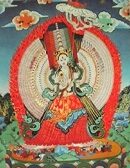 How does the Shurangama Samadhi differ from the nine concentrations described above?
The Shurangama Samadhi is a concentration already inherent in our own self-nature. It can therefore provisionally be called the concentration of self-nature. The concentration of self-nature has three characteristics:
– Wondrous concentration: Even amid the confusion and agitation of karmic conditions, the original self-nature is always settled. Cultivation is simply the process of returning to this original concentration. If concentration must be newly cultivated in order to exist, it is not yet wondrous concentration.
– Perfect concentration: Not only is the mind itself unmoving, but all things and phenomena are encompassed in this unmoving state. If one merely restrains the mind to keep it still, this is not yet perfect concentration.
– Great concentration: Movement and stillness are fundamentally one. If one still enters and exits concentration, it is not yet great concentration.
The great underlying cause is the esoteric cause. This cause is entirely different from ordinary causes. Ordinary people cannot understand it, practitioners of non-Buddhist paths cannot understand it, and practitioners of the Two Vehicles—Shravakas and Pratyekabuddhas—have not yet awakened to it.
Therefore, the reason for the appearance of the Shurangama Sutra is profound. The sutra’s great, transcendent meaning is definitive and complete. This is the ultimate destination of those who cultivate the Way, leading to realization. Its great practice encompasses the countless practices of Bodhisattvas.
The Great Shurangama Samadhi is the king of all concentrations because it is inherently present in self-nature. Therefore, it encompasses all concentrations and samadhis. When we return to our own self-nature, one samadhi is all samadhis, and all samadhis are one samadhi.
Wondrous Concentration
Wondrous concentration means that the original self-nature is inherently and perpetually settled.
“When the mind is pure, the moon appears in the water. When the mind is still, the sky is without clouds.”
(When the mind is pure, the moon is reflected on the surface of the water. When the mind is still, it is like a sky without a single cloud.)
If your mind is completely pure, the Buddha’s radiance will shine upon it and illuminate your mind like moonlight reflected on a still lake.
If your mind remains defiled, it is like a muddy, turbid pool through which no light can shine.
A concentrated mind is like a cloudless sky—a wondrous state that cannot be expressed in words. Once you have purified your own mind, you will possess the power of the Great Shurangama Samadhi.
The esoteric cause is the essence of concentration that everyone inherently possesses. It is called “esoteric” rather than “manifest” because, although it is fully present within every person and no one lacks it, no one knows that it is there. That is why it is called esoteric.
This esoteric cause is the concentration power of the Tathagata and also the essential basis of concentration for all sentient beings. The difference is that the essential concentration power of sentient beings has not yet been revealed, so it remains hidden.
Allow these thoughts to settle, release them, and purify them. Let your mind become empty.
Accomplishing the work of the Way means truly recognizing the power of right concentration and the clear wisdom that are inherently present, complete, and fully developed within every person. These powers of right concentration and wisdom mutually encompass and complete one another without obstructing one another.
This is recognizing the true essential nature that already exists within oneself. It means recognizing one’s own true mind.
Perfect Concentration
Perfect concentration means that the mind remains unmoving while encompassing all things and phenomena in an unmoving state.
Whether entering or leaving concentration, one remains in a state of suchness, unmoving yet constantly clear and bright. One trusts in the power of vows and practice, remaining firm and unmoving.
For example:
All waters share the same essential nature.
The eight meritorious qualities of their taste do not differ.
Because the causes are planted in different places,
The resulting waters have various differences.
The eight meritorious qualities of water are clarity, freshness, sweetness, lightness, nourishment, harmony, quenching thirst, and providing benefit.
For example, all water shares the same essential nature. Water possesses eight meritorious qualities, and these qualities do not differ. Because all sentient beings plant different causes at the stage of cultivation, they experience different karmic results when those causes mature.
It is like suchness: it does not arise in the past, does not move in the future, and does not originate in the present.
Great Concentration
Great concentration means that movement and stillness are fundamentally one. If one still enters and exits concentration, it is not yet great concentration.
The Chinese character 大 (Great) means vast or immense. It refers to four great aspects of the Shurangama Sutra:
-
Cause (因).
-
Meaning or principle (理).
-
Practice and cultivation (行).
-
Result or fruition (果).
Practitioners who cultivate this samadhi may experience the following states:
-
Entering concentration from within the body and emerging from concentration outside the body.
-
Entering concentration outside the body and emerging from concentration within the body.
-
Entering concentration through one body and emerging through another body.
-
Entering concentration through another body and emerging through the same body.
-
Entering concentration through a human body and emerging through the body of a Yaksha.
-
Entering concentration through the body of a Yaksha and emerging through the body of a dragon.
-
Entering concentration through the body of a dragon and emerging through the body of an asura.
-
Entering concentration through the body of an asura and emerging through the body of a deva.
-
Entering concentration through the body of a deva and emerging through the body of Brahma.
-
Entering concentration through the body of Brahma and emerging through the Desire Realm.
Bodhisattvas can manifest thousands upon thousands of millions of bodies and create innumerable emanations. There is no obstruction between one and another, between self and others, between inside and outside, or between sameness and difference. This is the wondrous functioning of a Bodhisattva’s supernatural powers.
When Bodhisattvas enter or emerge from concentration, they are not limited to their own bodies. At any time and in any circumstance, they can enter concentration or emerge from it. They are not restricted by time or space and function freely and spontaneously in a wondrous way beyond description.
Bodhisattvas can enter concentration in the heavens and emerge from it in the hells. They can enter concentration in the hells and emerge from it in the human world. They can enter concentration in the human world and emerge from it in another realm.
They can enter concentration through a thousand bodies and emerge through one body. They can enter concentration through one body and emerge through a thousand bodies. They can enter concentration through countless bodies and emerge through one body. They can enter concentration through one body and emerge through countless bodies.
Because Bodhisattvas teach and transform all sentient beings according to their circumstances, they can freely enter and emerge from concentration. This state fulfills their wishes exactly. Whatever they wish to do, they can do so without the slightest force or strain, functioning freely and spontaneously. Anyone who sincerely cultivates the Way can attain this state.
This state means that entering concentration is not something one must force oneself to accomplish. It is a matter of fulfilling one’s wishes naturally: whenever one wishes to enter concentration, one can enter it; wherever one wishes to emerge from concentration, one can emerge there. One is not restricted by time or space.
“Within, there is no mind; outside, there are no objects.
When there is neither mind nor objects, that is concentration.”