Contemplation of the impurity of the body
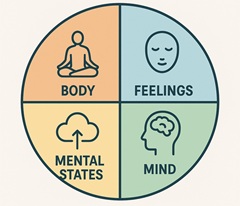 Contemplation of the impurity of the body is one of the practices of the Four Foundations of Mindfulness.
1. Contemplation of the impurity of the body.
2. Contemplation that feelings are suffering.
3. Contemplation that the mind is impermanent.
4. Contemplation that phenomena are without self.
Within, contemplate the mind and do not see the mind; externally, contemplate forms and do not see forms; from afar, contemplate objects and do not see that there are objects. The greed of worldly people, you too do not crave; the attachment of worldly people, you too do not cling. You completely eliminate the worldly person’s mind of sensual desire, and because you completely eliminate the worldly person’s mind of craving and attachment, a certain power of concentration arises. Once there is the power of concentration, you are no longer disturbed by any external circumstance. How can one attain this practice? First, one must cultivate the Four Foundations of Mindfulness. By contemplating that the body has nine openings that constantly discharge impure substances – the eyes have rheum, the nose has mucus, the ears have earwax, the mouth has phlegm, feces, urine. With a body so filthy, what is there to crave and cling to? Then contemplate that all the feelings and material enjoyments one constantly receives each day are, in fact, factors in suffering. Contemplate the impermanence of the mind: moment after moment it arises and ceases, nothing is eternal. Contemplate phenomena as without self: All phenomena, from time immemorial, are inherently quiescent, cannot be expressed through words, so how could there be a self? Bodhisattvas contemplate and cultivate the Four Foundations of Mindfulness, completely eliminating the five desires and craving. That is a brief explanation of the Four Foundations of Mindfulness.
Why must we cultivate this practice. Because of the two words “Love”. Do you know that the Chinese character Love 妖 is written with the “Woman 女” radical beside the character “ 夭 (short-lived)”. In short, a person who is deluded and dies young will become a demon. (Dying young because of sensual pleasure). In Classical Chinese, you can infer the meaning of the two characters “marriage 結 婚”. 婚 means darkness. Now we enter into the details of this Dharma.
– oOo –
Contemplation of the Impurity of the Body
Contemplate your own body. Contemplate the bodies of others. Contemplate the inner and outer body but have neither the perception of a body nor attachment.
When acting or meditating, often think of the suffering caused by one’s own ignorance. What does it mean to contemplate the inner activity of the body? When you are walking, know that you are walking, when standing, know that you are standing, when sitting, know that you are sitting , when lying down, know that you are lying down. You clearly know the body’s actions. That is contemplating one’s own body while acting, while meditating, always remembering the suffering and affliction of the body. As you go out and come in, move back and forth, remain at ease, remember without forgetting, sitting and lying on either side remain calm, wear the three robes according to the Dharma without losing proper deportment, practice Prajñāpāramitā. You contemplate your own inner and outer body, cultivating in this way without attachment.
You always observe the in-breath and the out-breath. Knowing a long breath as a long breath, knowing a short breath as a short breath. Like the potter’s wheel, which can be made fast or slow through control. You observe your own breath and thoughts, this is contemplation of the inner body, whether active or meditating, always thinking of the suffering and foolishness of the body. In practicing this Prajñāpāramitā, you constantly contemplate and distinguish the four elements: earth, water, fire, wind of the body, like slaughtering an ox and then dividing it into four parts. You contemplate the four distinct parts of the body, which have always been so from time immemorial. That is contemplating both the inner and outer body without attachment
You contemplate the body from head to toe, entirely consisting of impure things: hair, body hair, teeth, nails, bones, marrow, the five organs and thirty-six substances, none of which is worthy of craving. Like the granaries of farmers filled with grain, a person with open eyes opens the granaries and analyzes them, knowing them clearly. You contemplate the things inside the body in the same way. That is contemplating your own inner body, while living and while meditating, constantly remembering the delusion, attachment and suffering of the world, so there is nothing to cling to.
You contemplate the human body, from the day it first dies to the fifth day; the body swells up, becomes dark and purple, rots, blood and pus spread everywhere, with no place remaining clean; or it is eaten by birds and animals, either completely eaten or half eaten, disgusting, foul and impure; or a dead person has only tendons clinging to bones, with blood flowing everywhere; or a dead person has lost all flesh and blood, with tendons and bones mixed together; or a dead person has lost all flesh and blood, with only tendons and bones scattered everywhere; or a person who has been dead for a long time, the bones burned and turned blue, white, crumbled to pieces or become the same color as the earth. You all arouse this thought, contemplate in this way and then return to contemplate your own body, if you have not yet been liberated and have not yet departed from this Dharma, you too will be like this. That is contemplating the Dharma in one’s own body and in the bodies of others so as to no longer crave or become infatuated.
Body feeling mind Dharma, internally and externally contemplate
All worldly craving and attachment are eliminated
– oOo –
Is the body the holy life?
When the Buddha attained enlightenment, Mara sent three demonesses to the foot of the bodhi tree to disrupt the Buddha’s cultivation. They said to the Buddha: “We are heavenly beauties, and now we offer ourselves to You, to attend upon You. We vow to serve You in whatever You need.” The Buddha sat quietly in meditation without saying anything, his body and mind unmoved, and emitted a stream of white radiance that illuminated the demonesses. At that time, the three demonesses contemplated their own bodies and saw that they were exceedingly foul-smelling, with the nine openings exuding filthy and putrid substances. They saw their large and small intestines, the sheng-zang and re-zang (undigested food is sheng-zang, and digested food is re-zang). There were many tiny worms frolicking inside the large and small intestines, swimming back and forth very freely. Having seen this, the three demonesses became disgusted and left.
If the body is the holy life, then one should know that the holy life is therefore not wholesome, therefore not Dharma, therefore turbid, therefore foul-smelling, therefore impure, therefore disgusting, therefore contrary, therefore defiled, therefore a corpse, therefore an accumulation of worms.
1). Therefore not wholesome: The body is not pure, therefore it is not wholesome. The holy life is pure, therefore it is wholesome. If one says that the holy life is the body, then the holy life is therefore not wholesome.
2). Therefore contrary to the Dharma: The body sometimes does things that are contrary to the Dharma. If the holy life is the body, then the holy life is also contrary to the Dharma.
3). Therefore turbid: The body is a turbid and impure thing, while the holy life is pure and undefiled. Therefore it is said that the body is not the holy life, and the holy life is also not the body.
4). Therefore foul-smelling: The body is a foul-smelling thing. If the holy life is the body, then the holy life becomes foul-smelling.
5). Therefore impure: The body is impure, and the nine openings constantly exude impure substances. If the holy life is the body, then the holy life becomes impure. We should contemplate the five kinds of impurity. In the Great Treatise on the Perfection of Wisdom, there are five verses describing the five kinds of impurity.
6). Therefore disgusting: The body is a disgusting thing that causes people to feel no joy. If one says that the body is the holy life, then is that not the holy life that causes people to feel disgust? No. The holy life causes people to feel joy, therefore it is said that the body is not the holy life.
7). Therefore contrary: The body constantly does things contrary to the mind’s intentions. For example, the mind does not want to kill, steal, commit sexual misconduct, lie, or drink alcohol. But the body insists on going to do these things, not listening to the mind’s commands and control; this is contrary behavior. The holy life is not like this, but acts in accordance with reason and proper intention, therefore the holy life is absolutely not the body.
8). Therefore defiled: Because the body is formed from the four great elements, it is defiled. However, the holy life is not defiled, but pure, therefore the body is not the holy life.
9). Therefore a corpse: Because the body will eventually die, and a corpse is something that people do not rejoice in, while the holy life causes people to rejoice, therefore the holy life is not the body. If one says that the body is the holy life, then is the holy life not a corpse? No, the holy life is pure.
10). Therefore an accumulation of worms: This body is formed by many worms accumulating together. Our human body is a large worm, and within the body there are hundreds of millions of tiny worms, organized into a single community and living together. The Great Sa Ba Treatise says: ‘’Within the human body, everything is an accumulation of worms, the heads of the worms are inside, eating what humans eat; the tails of the worms are outside, carrying out their work.’’ When we drink water and eat food, it is the large worm using the small worms to do the work. Hundreds of millions of tiny worms sit back and enjoy themselves, without expending any effort, and after eating, they are very carefree, very at ease!
– oOo –
Ten Contemplations of the Body
Having contemplated in this way, one does not grasp at the body, does not cling to one’s cultivation, and does not abide anywhere in the Dharma. The past has ceased, the future has not arrived, the present is quiescent, no one creates karma, no one receives karmic retribution, this life does not move, and another life does not change.
1). Not grasping at the body: Contemplating one’s own body, one cannot find any place of the holy life.
2). Not clinging to one’s cultivation: If one cultivates, one should not abide in the holy life. If in one’s mind there is an attachment thinking: I cultivate the holy life, then one cannot reach the realm of emptiness of person and emptiness of Dharma.
3). Not abiding anywhere in the Dharma: One also has no attachment to any and all Dharma.
4). The past has ceased: The past life has already ceased, it does not exist.
5). The future has not arrived: The future life has not yet arrived.
6). The present is quiescent: In the present life, there is nothing at all.
7). No one creates karma: Since the three times are all empty, the body is also empty, the mind is also empty, the world is also empty, everything whatsoever is empty, then naturally there is no one who creates karma.
8). No one receives retribution: If there is no one who creates karma, then who is there to receive retribution? Therefore there is no one who receives retribution.
9). This life does not move: This world also does not move.
10). Another life does not change: Another world also does not change, remaining as it is.
Contemplate in this way: Because the body is not the holy life. Because the Dharma of the holy life cannot be obtained. Because the Dharma of the three times is all quiescent. Because the mind does not grasp. Because the mind is unobstructed. Because the place of cultivation is non-dual. Because skillful means are at ease. Because receiving the Dharma is without characteristics. Because contemplating the Dharma is without characteristics. Because one knows the equality of the Buddhas. Because one possesses all Buddha-Dharmas. Thus is called the pure Holy Life.